Choosing food for a Yorkshire Terrier is less about finding a special “Yorkie formula” and more about getting the details right at toy-dog scale.
A few extra treats, a slightly oversized scoop, or a calorie-dense food can represent a meaningful share of such a small dog’s daily intake. Puppies bring another consideration: very young toy puppies can be vulnerable to hypoglycemia if adequate intake is not maintained.
Dental health also deserves unusual attention in this breed, while conditions such as patellar luxation and congenital portosystemic shunts require a clear distinction between sensible everyday nutrition and diets used for diagnosed medical problems.
The best food is therefore the one that fits your Yorkie’s life stage, calorie needs, body condition, health, and individual tolerance — not simply the food with the most breed-specific marketing.
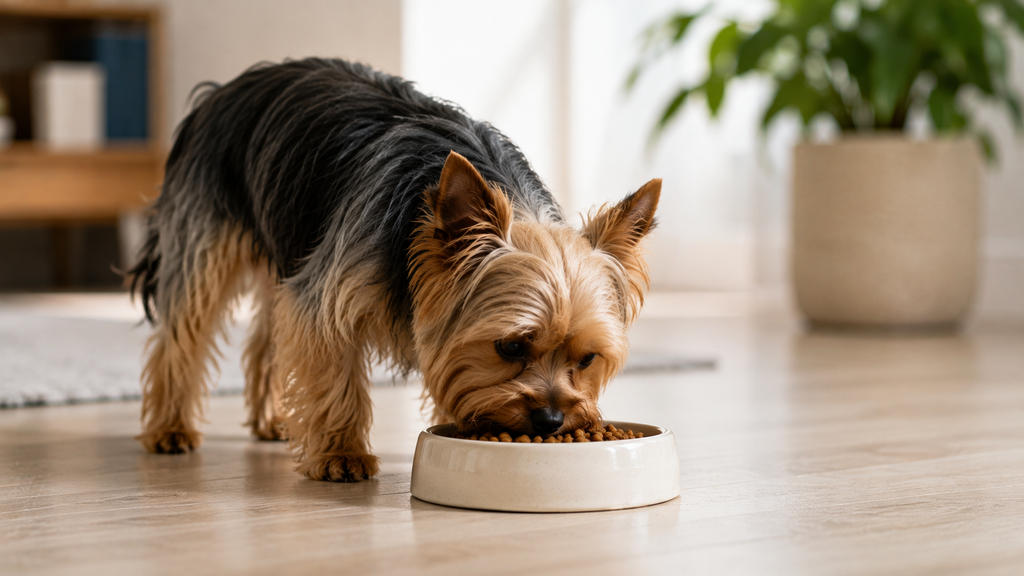
What should you look for in Yorkshire Terrier food?
Start with nutritional adequacy.
For a healthy Yorkie, look for:
- A complete and balanced diet appropriate for the correct life stage
- A calorie density that makes practical portion control possible
- A portion size you can measure consistently
- A formulation your individual dog eats and tolerates well
- Appropriate manufacturer nutritional expertise and quality control
- Clear calorie and feeding information
- A format that works with your dog’s dental status and eating ability
There is no scientifically established Yorkshire Terrier percentage of protein, fat, or fiber that every dog in the breed should receive.
Those decisions depend on life stage, calorie needs, activity, body condition, health, and the individual dog.
With a Yorkie, small portions deserve real precision
Portion control matters in every dog.
The practical difference with a Yorkshire Terrier is scale.
When the dog’s entire daily energy budget is small, an amount of cheese, training treats, chews, or table food that looks insignificant to a person can represent a substantial addition to the day’s calories.
That makes “just a little extra” worth counting.
Think in calories, not just scoop size
The same volume of two foods can provide different amounts of energy.
When comparing foods, check calories per cup, can, tray, or gram rather than assuming similar-looking portions are nutritionally equivalent.
Start with the manufacturer’s feeding guidance, then adjust according to:
- Body condition
- Weight trend
- Activity
- Treat intake
- Life stage
- Health changes
Do not rely indefinitely on the feeding chart if your dog’s body condition is telling you something different.
Treats count quickly at toy-dog scale
Training rewards and chews are part of the total intake.
Keep rewards small enough for the job they need to do.
A Yorkie does not need a large piece of food every time you reward a behavior.
If you train frequently, using appropriately sized rewards or part of the normal daily food allowance can make calorie management easier.
Yorkshire Terrier puppies need a different conversation
A growing Yorkie needs a complete and balanced diet formulated for growth.
But very young and very small toy puppies also deserve particular attention to maintaining adequate food intake.
Juvenile toy-breed puppies can be vulnerable to hypoglycemia.
That is a puppy-specific concern. It should not be turned into a rule that healthy adult Yorkshire Terriers must eat constantly throughout life.
Feeding a very young toy puppy
Follow the feeding routine recommended by your veterinarian and the appropriate growth-food guidance for your individual puppy.
Pay attention to whether the puppy is actually eating rather than simply putting food down and assuming enough has been consumed.
Major changes in appetite deserve more attention in a tiny young puppy than they might in a healthy adult dog.
Weakness, trembling, disorientation, collapse, unusual sleepiness, or other concerning signs in a young puppy require prompt veterinary attention.
Do not try to manage suspected hypoglycemia with an improvised home feeding protocol instead of seeking veterinary advice.
As your Yorkie grows
Continue monitoring:
- Actual food intake
- Weight
- Body condition
- Growth
- Appetite
- Energy and general wellbeing
The objective is appropriate development, not maximizing weight gain.
As puppyhood ends, feeding frequency and calorie intake can be reassessed for the individual adult rather than continuing a puppy routine automatically.
Dental health changes how Yorkie owners should think about food
Dental health is particularly relevant in Yorkshire Terriers.
Toy dogs can face a substantial periodontal disease burden, and persistent deciduous teeth are also an important concern in Yorkies.
But this does not make ordinary dry food a dental-care program.
Does kibble clean a Yorkie’s teeth?
Do not assume that feeding standard kibble provides enough mechanical cleaning to prevent periodontal disease.
Likewise, wet food should not automatically be blamed for dental disease simply because it is soft.
Food format and texture can matter practically, especially if a dog already has dental problems, but choosing dry versus wet food does not replace:
- Regular oral checks
- Appropriate home dental care
- Veterinary dental assessment
- Treatment when dental disease is present
If retained puppy teeth, painful chewing, difficulty eating, significant bad breath, loose teeth, or other oral problems are present, address the dental problem rather than trying to solve it by switching food texture alone.
Dry, wet, fresh or home-prepared: which is best for a Yorkie?
No single food format is inherently best for Yorkshire Terriers.
The better choice is the format that delivers appropriate nutrition and works for the individual dog.
Dry food
Dry food is convenient to store and measure.
For a very small dog, kibble size and ease of chewing may also matter practically.
Do not assume that standard kibble alone will protect dental health.
Wet food
A complete and balanced wet food can be used as the main diet.
It may also be practically easier for some dogs with chewing limitations.
Check whether the product is intended for complete daily feeding rather than supplemental use only.
Commercial fresh food
A commercial fresh diet can be appropriate if it is nutritionally complete and balanced for the dog’s life stage.
Terms such as “fresh” or “human-grade” do not by themselves establish that a diet is superior for Yorkshire Terriers.
Calorie density still matters, even when the food looks less processed.
Home-prepared food
Home-prepared feeding requires proper formulation.
Meat, vegetables, rice, and a few supplements do not automatically produce a nutritionally complete diet.
If a homemade diet will provide most or all of your Yorkie’s nutrition long term, use a recipe formulated for the individual dog by an appropriately qualified veterinary nutrition professional.
How feeding changes from one Yorkie to another
Breed tells you only part of the story.
The useful feeding decision comes from combining breed-relevant considerations with the dog in front of you.
Healthy adult companion Yorkie
For a healthy adult, prioritize:
- Complete and balanced adult nutrition
- Measurable portions
- Appropriate calorie density
- Healthy body condition
- Consistent weight
- Individual tolerance
A small-breed formula can be convenient because kibble and recommended portions may be designed with smaller dogs in mind.
It is not a physiological requirement simply because the package says “small breed.”
Highly active Yorkie
A particularly active individual may use more energy than a quieter dog of similar size.
That does not establish a special high-protein or high-fat requirement for the breed.
Adjust energy intake according to actual activity, body condition, and weight trend.
Lower-activity Yorkie
When activity drops, previous portions may become excessive.
This can happen with aging, lifestyle changes, recovery from illness or injury, or simply a quieter routine.
Reassess the amount being fed before assuming you need a completely different type of food.
Older Yorkie
There is no universal birthday when every Yorkshire Terrier needs senior food.
Instead, aging should prompt you to reassess:
- Calorie requirements
- Body condition
- Muscle condition
- Activity
- Appetite
- Dental status
- Medical conditions
Dental disease can become especially relevant to the practical choice of food texture in an older Yorkie.
Do not automatically restrict protein simply because a dog is older.
Body condition matters for more than appearance
Keeping a Yorkie at an appropriate body condition is a basic nutritional goal.
It also matters in the context of several breed-relevant health concerns.
Patellar luxation is an orthopedic concern in Yorkshire Terriers. Nutrition cannot prevent luxating patella through a special ingredient, but avoiding unnecessary excess body weight is a sensible way to limit additional load on the dog’s joints.
Tracheal collapse is another recognized concern in the breed. Food does not prevent or cure tracheal collapse, but maintaining an appropriate body condition avoids adding unnecessary weight burden in a dog with airway disease.
Neither concern means every Yorkie needs joint food, glucosamine, or another supplement.
Start with body condition before turning breed predispositions into supplement purchases.
What about liver diets and Yorkshire Terriers?
Yorkshire Terriers have a recognized predisposition to congenital portosystemic shunts.
That fact matters.
It does not mean a healthy Yorkie should be fed a preventive liver diet or a low-protein diet.
There is an important boundary:
A healthy Yorkshire Terrier does not need therapeutic nutrition simply because the breed has a predisposition to a particular disease.
A dog diagnosed with a portosystemic shunt or another liver condition may have different nutritional requirements depending on the individual case.
Those diets belong under veterinary management.
Do not restrict protein in a healthy Yorkie in an attempt to prevent a condition that has not been diagnosed.
Does a Yorkshire Terrier need low-fat food?
Not automatically.
Pancreatitis can be clinically relevant in this breed and toy-dog context, but that does not establish a universal low-fat requirement for every healthy Yorkshire Terrier.
Dietary fat contributes substantially to energy density, so it is useful to consider when managing portions in a very small dog.
That is different from declaring a single ideal fat percentage for the breed.
If your Yorkie has diagnosed pancreatitis or a relevant medical history, follow the dietary plan recommended by your veterinarian rather than applying a generic Yorkshire Terrier feeding rule.
What if your Yorkie has itching, soft stools or another suspected food problem?
Do not assume the cause is food simply because symptoms involve the skin or digestive tract.
Individual Yorkshire Terriers can develop gastrointestinal problems or adverse food reactions, but that does not justify labeling sensitive digestion or a particular food allergy as a universal breed characteristic.
There is no useful breed-based list of ingredients that every Yorkie should avoid.
Chicken, beef, grains, or other ingredients should not be removed solely because the dog is a Yorkshire Terrier.
If food allergy is genuinely suspected
Repeated food switching makes patterns harder to interpret.
If symptoms are persistent enough to raise concern about an adverse food reaction, discuss them with your veterinarian.
A proper diagnostic elimination diet is controlled and followed by an appropriate challenge.
Changing from chicken to salmon for a few days and seeing temporary improvement does not confirm a food allergy.
Persistent vomiting or diarrhea, weight loss, significant skin disease, repeated ear problems, appetite loss, or other concerning symptoms warrant veterinary assessment.
Should Yorkshire Terriers eat grain-free food?
There is no Yorkshire Terrier-specific reason to feed grain-free routinely.
“Grain-free” does not automatically mean:
- Higher quality
- Hypoallergenic
- Easier to digest
- Better suited to toy dogs
Choose food according to nutritional adequacy, formulation, calorie suitability, individual tolerance, and health needs rather than treating the absence of grains as a quality marker.
Protein and fat: ignore breed-specific percentage rules
There is no established protein percentage that all Yorkshire Terriers should eat.
There is also no established fat percentage that is ideal for every Yorkie.
Protein should be adequate for the dog’s life stage and individual situation.
Fat should be considered partly in terms of energy density and the dog’s actual calorie requirements.
Avoid shortcuts such as:
“Yorkies need high protein because they are energetic.”
or:
“Yorkies should always eat low fat because of pancreatitis.”
Neither is a sound universal feeding rule.
How to compare two foods for a Yorkshire Terrier
When two foods both look appealing, compare the information that actually affects your dog.
Ask:
- Is it complete and balanced for the correct life stage?
- How many calories does it provide per cup, can, tray, or gram?
- Can I measure an appropriate portion accurately at Yorkie scale?
- Is the food practical for this dog’s chewing and dental status?
- Does my dog maintain an appropriate body condition on it?
- Does my dog tolerate it consistently?
- What nutritional expertise is involved in formulation?
- What quality-control information does the manufacturer provide?
- Can I feed it consistently over time?
Do not let “premium,” “natural,” breed imagery, or an attractive ingredient list make the decision for you.
The best food is the one that meets the individual dog’s nutritional requirements and works reliably in real life.
Changing your Yorkie’s food
Yorkshire Terriers do not require a breed-specific transition schedule.
For dogs generally, gradually replacing the previous food with the new one over several days can make a change easier to tolerate.
Some dogs transition comfortably within a shorter period. Others need more time.
Keep other diet changes limited during the transition so you can interpret what happens.
If your dog develops persistent diarrhea, repeated vomiting, loss of appetite, marked lethargy, blood in the stool, or other concerning symptoms, contact your veterinarian rather than assuming the food change is the only possible explanation.
Be especially cautious about prolonged food refusal in a very young or very small toy puppy.
Common Yorkshire Terrier feeding mistakes
Eyeballing tiny portions
A small measuring error can represent a meaningful amount of a toy dog’s daily intake.
Measure consistently rather than relying on what “looks about right.”
Forgetting treats because each one looks small
Five tiny extras are still five extras.
Count rewards, chews, and table food as part of the day’s intake.
Treating puppy hypoglycemia risk as a lifelong feeding rule
The concern is particularly relevant to vulnerable young toy puppies.
It does not mean every healthy adult Yorkie needs constant access to food or a puppy-style meal schedule.
Using ordinary kibble as the dental plan
Dental disease requires its own prevention and veterinary strategy.
Food format alone is not enough.
Restricting nutrients because of breed predispositions
A predisposition to portosystemic shunts does not mean every healthy Yorkie needs low protein.
Clinical relevance of pancreatitis does not mean every healthy Yorkie needs low fat.
Patellar luxation does not mean every Yorkie needs joint supplements.
Predisposition is not a prescription.
Assuming skin or digestive symptoms identify an ingredient
Symptoms alone do not prove food allergy or tell you which ingredient is responsible.
Avoid creating unnecessary restrictions without a sound diagnostic reason.
FAQ — Yorkshire Terrier food
What is the best food for a Yorkshire Terrier?
There is no single best food for every Yorkie.
Choose a complete and balanced diet for the correct life stage, then consider calorie density, portion practicality, body condition, dental status, individual tolerance, activity, and any genuine medical requirements.
How much should a Yorkshire Terrier eat?
There is no universal breed-wide amount.
Start with the food manufacturer’s guidance, measure the portion carefully, include treats and extras, and adjust according to body condition and weight trend.
Because Yorkies are so small, precision is more useful than relying on cups alone.
How often should a Yorkshire Terrier eat?
There is no single meal frequency appropriate for every Yorkie throughout life.
Very young toy puppies may need particular attention to maintaining adequate intake because of hypoglycemia risk.
Healthy adults can have feeding frequency individualized to their routine, total calorie needs, and medical circumstances.
Does my Yorkie need small-breed dog food?
Not necessarily.
Small-breed foods can offer practical advantages such as smaller kibble and portions designed around smaller dogs, but the label itself does not make the food nutritionally necessary or superior.
Is dry food better for Yorkshire Terrier teeth?
Ordinary dry food should not be considered a substitute for dental care.
Dental health is particularly important in Yorkies, so oral hygiene and veterinary dental assessment remain important regardless of whether the main diet is dry, wet, or another format.
Are Yorkshire Terriers prone to food allergies?
An individual Yorkie can develop an adverse food reaction, but you should not assume chicken, beef, grains, or another ingredient is a problem simply because of breed.
Persistent symptoms should be evaluated properly rather than managed through repeated random ingredient exclusions.
Should a Yorkshire Terrier eat low-fat food?
Not simply because it is a Yorkshire Terrier.
A diagnosed condition such as pancreatitis can change dietary requirements, but that is an individual medical decision rather than a universal breed rule.
Does my Yorkie need joint supplements?
Not automatically.
Maintaining an appropriate body condition is a more fundamental nutritional priority.
If your dog has an orthopedic condition or mobility problem, discuss diet and supplementation with your veterinarian based on the individual case.
Next steps
For breed-specific health concerns:
Yorkshire Terrier health guide
For broader feeding and nutrition guidance:
Affiliate disclosure
Doglira may earn a commission from qualifying purchases made through links on this site, at no additional cost to you.
Recommendations should remain based on nutritional suitability and usefulness to the reader, whether or not a product offers an affiliate commission.