Yorkshire Terriers are generally long-lived dogs, but several health problems have unusually strong relevance to the breed.
Dental disease deserves particularly high priority. Patellar luxation and tracheal collapse are important structural concerns. Congenital portosystemic shunts provide a much more meaningful Yorkie-specific gastrointestinal and metabolic health story than the familiar “sensitive stomach” stereotype. Very young toy puppies can also be vulnerable to juvenile hypoglycemia, while inherited eye disease and Legg-Calvé-Perthes add important screening and orthopedic context.
None of these predispositions means every Yorkshire Terrier will be affected.
The useful goal is to understand which risks genuinely matter, what changes owners may notice, what screening can tell you, and when veterinary evaluation should not be delayed.
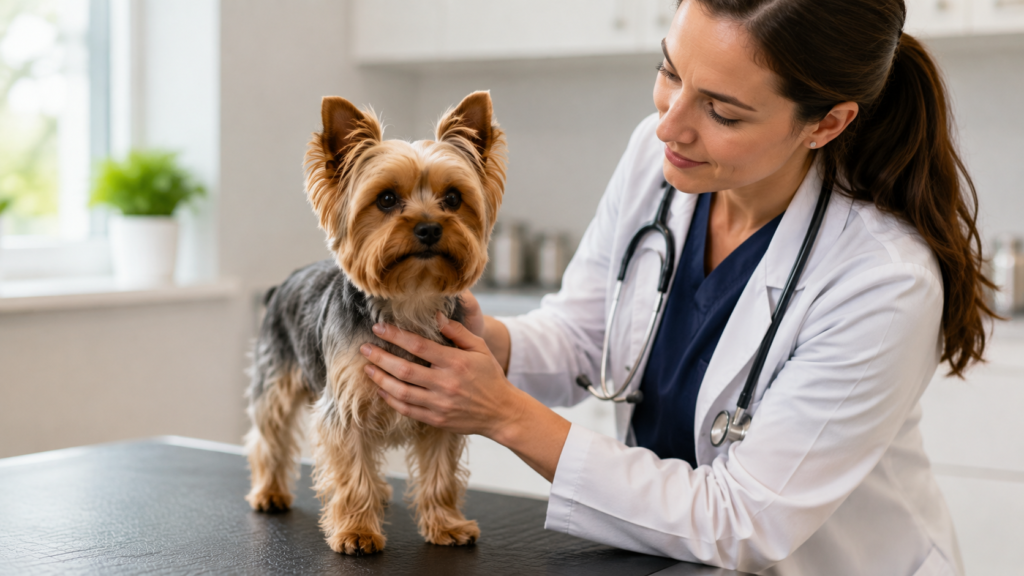
Yorkshire Terrier health at a glance
The main breed-relevant health areas worth understanding are:
- Periodontal and dental disease
- Retained deciduous teeth
- Patellar luxation
- Tracheal collapse
- Congenital portosystemic shunts
- Hypoglycemia in very young toy puppies
- Primary lens luxation and other inherited eye disease
- Legg-Calvé-Perthes disease
These problems are very different from one another.
Some can be meaningfully reduced through routine care, as with dental plaque control.
Some are developmental or inherited conditions that owners cannot simply prevent.
Some have useful screening tests.
Others are diagnosed only after clinical investigation.
That distinction matters more than trying to build a generic Yorkie “prevention checklist.”
Dental and periodontal disease in Yorkshire Terriers
Dental disease deserves unusually high priority in this breed.
In a large Yorkshire Terrier primary-care study, periodontal disease was the most commonly recorded specific disorder, while retained deciduous teeth were also disproportionately relevant. That does not mean every Yorkie will develop dental disease, but it gives oral health much stronger breed-specific justification than a generic reminder to brush a dog’s teeth.
Periodontal disease is more than visible tartar
Several terms are often used interchangeably even though they describe different things.
Plaque is the bacterial biofilm that accumulates on teeth.
Calculus, or tartar, is mineralized plaque.
Gingivitis refers to inflammation of the gums.
Periodontitis involves deeper structures that support the teeth.
A dog can also have important disease below the gumline that is not obvious during a casual look at the mouth.
That is why visible tartar alone cannot tell you how advanced periodontal disease is.
What owners may notice
Possible oral-health warning signs include:
- Persistent bad breath
- Visible tartar or calculus
- Red or bleeding gums
- Loose teeth
- Difficulty chewing
- Dropping food
- Reluctance to chew harder items
- Pawing at the mouth
- Reduced appetite when oral discomfort becomes significant
Some affected dogs show surprisingly little obvious pain.
Do not wait for a Yorkie to stop eating before taking dental disease seriously.
Retained puppy teeth are especially relevant in Yorkies
A retained deciduous tooth remains in place after the corresponding adult tooth begins to erupt.
This is genuinely relevant in Yorkshire Terriers rather than being generic puppy filler.
Owners should pay attention as permanent teeth emerge and have persistent puppy teeth assessed rather than assuming they will always fall out eventually.
Not every Yorkie puppy will retain teeth.
But the problem occurs often enough in the breed to deserve deliberate attention.
Daily toothbrushing is the strongest home-care target
For home plaque control, daily brushing is the ideal target.
If daily brushing is not realistic, consistent brushing is still better than doing nothing.
What should not be implied is that brushing once a week provides the same plaque-control benefit as daily care.
Start mouth handling early when possible so brushing becomes a normal part of life rather than a wrestling match introduced after disease has already developed.
What about dental chews and dental diets?
Products accepted by the Veterinary Oral Health Council can provide evidence-based plaque or tartar control.
They can be useful additions to an oral-care program.
They do not automatically replace toothbrushing or professional veterinary dental care.
Likewise, ordinary kibble should not be described as a dental-cleaning system simply because it is dry or crunchy.
Some specifically formulated dental diets have demonstrated oral-health benefits.
Standard dry food is not equivalent.
Professional dental care matters too
Veterinary dental assessment can identify disease that is difficult or impossible to evaluate properly at home.
The timing of professional dental procedures should be individualized according to the dog’s oral health rather than imposed through one universal yearly schedule.
Anesthesia-free cleaning should also not be treated as equivalent to comprehensive veterinary dentistry.
Cleaning visible tooth surfaces without appropriate anesthesia does not allow the same complete periodontal examination, dental radiography, or treatment below the gumline.
Patellar luxation
Yorkshire Terriers have a strong breed predisposition to patellar luxation.
The patella is the kneecap.
With patellar luxation, it moves out of its normal groove.
In Yorkies and many other small dogs, medial luxation — movement toward the inside of the leg — is the more characteristic pattern.
Large primary-care epidemiology has found substantially elevated odds of patellar luxation in Yorkshire Terriers compared with crossbred dogs, and patella evaluation is also part of current US breed-health screening recommendations.
What owners may notice
Possible signs include:
- Intermittently carrying a hind leg
- A brief skipping gait
- Intermittent lameness
- Persistent lameness in more significant cases
- Reluctance to jump
- Discomfort
- Progressive mobility problems
The classic few-step “skip” can be suggestive.
It does not diagnose patellar luxation.
Other orthopedic problems can produce altered gait too.
Severity varies considerably
A mildly affected Yorkie may have a luxating patella found incidentally during an examination.
Another dog may experience repeated lameness, discomfort, or progressive degenerative change.
This is why treatment decisions are based on the individual dog’s clinical severity rather than simply the existence of the condition.
Can owners prevent patellar luxation?
The underlying developmental and genetic predisposition is not something an owner can reliably eliminate by banning stairs, couches, or jumping.
Ramps or environmental changes can be useful management tools for some affected dogs.
That is different from claiming they prevent the condition from developing.
Maintaining appropriate body condition can also reduce unnecessary joint loading.
It cannot remove the underlying predisposition.
Screening matters before symptoms appear
Patellar evaluation is one of the current core US parent-club health recommendations for Yorkshire Terriers.
That is especially relevant in breeding dogs because screening can identify orthopedic status before a dog necessarily develops obvious mobility problems.
Tracheal collapse
Tracheal collapse is one of the strongest genuinely Yorkshire Terrier-specific health concerns.
This is the term owners should know.
“Tracheal sensitivity” is too vague and can blur ordinary coughing with a recognized structural airway disorder.
In tracheal collapse, weakened cartilage allows part of the trachea to narrow dynamically, restricting airflow.
Yorkshire Terriers are strongly overrepresented among affected dogs, and newer Yorkie-specific clinical research reinforces the association.
The classic honking cough
A characteristic presentation is a chronic dry cough often described as a “goose honk.”
Coughing may become more noticeable with:
- Excitement
- Exercise
- Heat
- Pressure or irritation around the neck
Some dogs also develop increased respiratory effort.
Not every Yorkie cough is tracheal collapse.
Heart disease, bronchial disease, infection, irritation, and other respiratory conditions can also cause coughing.
Persistent coughing deserves proper assessment rather than diagnosis from the sound alone.
Severe airway signs are an emergency
More advanced airway compromise can result in:
- Significant difficulty breathing
- Blue or gray mucous membranes
- Collapse
- Fainting or syncope
Those signs require urgent veterinary care.
Does a collar cause tracheal collapse?
It is too broad to say collars cause the disease.
The underlying condition is multifactorial.
However, reducing unnecessary pressure directly over the neck is sensible in a dog with tracheal disease or significant coughing.
A well-fitted harness can reduce leash pressure on the cervical trachea.
It does not prevent tracheal collapse.
What can make symptoms worse?
Depending on the individual dog, coughing or respiratory difficulty may become more noticeable with:
- Heat
- Excitement
- Exercise
- Airway irritants such as smoke
- Excess body condition when the dog is overweight
These are exacerbating factors or management considerations.
They are not necessarily the original cause of the structural disease.
How is tracheal collapse diagnosed?
Veterinary investigation may include:
- Clinical examination
- Neck and chest radiographs
- Fluoroscopy to observe dynamic airway collapse
- Bronchoscopy in selected cases
The appropriate diagnostic approach depends on the dog and the severity of the problem.
Portosystemic shunts in Yorkshire Terriers
Congenital portosystemic shunts are one of the strongest breed-specific health concerns in Yorkshire Terriers.
A portosystemic shunt, or PSS, is an abnormal blood vessel that allows portal blood to bypass normal processing by the liver.
Yorkies have demonstrated markedly elevated risk in breed-specific research, with evidence supporting a hereditary component.
This is a far more defensible Yorkie health topic than calling the breed generally prone to “sensitive digestion.”
What owners may notice
PSS can produce several different types of signs.
Possible presentations include:
- Poor growth
- Being unusually small compared with littermates
- Poor appetite
- Vomiting
- Diarrhea
- Urinary problems
- Episodic disorientation
- Unusual behavior
- Staring episodes
- Wobbliness or ataxia
- Seizures
Neurological signs can result from hepatic encephalopathy, in which substances normally processed by the liver affect brain function.
Symptoms may fluctuate.
Some dogs can appear relatively normal between episodes.
Can signs get worse after eating?
Neurological abnormalities can sometimes become more noticeable around meals because portal blood is bypassing normal hepatic processing.
That is useful clinical context.
It does not mean every Yorkie that acts strangely after eating has a liver shunt.
How is a liver shunt investigated?
The veterinary workup may involve:
- Blood tests
- Urinalysis
- Bile-acid testing
- Ammonia testing
- Ultrasound
- CT or other specialized imaging
An abnormal bile-acid or liver-function result alone does not prove that a PSS is present.
It indicates that additional investigation may be needed.
Is there a DNA clearance for Yorkie liver shunts?
Not currently in the simple sense available for some single-gene inherited disorders.
There is strong evidence of hereditary susceptibility in Yorkshire Terriers, but ordinary congenital Yorkie PSS does not have one routine predictive DNA test that can simply label every puppy clear.
Family history can therefore be useful.
It cannot guarantee that a puppy will be unaffected.
Healthy Yorkies do not need preventive liver diets
A healthy Yorkshire Terrier should not be placed on protein restriction or a therapeutic liver diet simply because the breed is predisposed to PSS.
Nutrition can become clinically important after diagnosis.
That belongs under individualized veterinary management.
Do not try to prevent a congenital shunt through homemade dietary restriction.
Hypoglycemia in very young Yorkshire Terrier puppies
Juvenile hypoglycemia is real, but it needs narrow framing.
Very young and very small toy-breed puppies can be vulnerable to low blood glucose, particularly during approximately the first months of life.
This is not evidence that healthy adult Yorkshire Terriers are broadly hypoglycemia-prone throughout life.
When risk is most relevant
Risk becomes more important in the context of:
- Very young age
- Very small body size
- Inadequate intake
- Missed meals
- Prolonged fasting
- Concurrent illness
Very young toy puppies may therefore need regular, frequent access to appropriate nutrition.
Exact feeding schedules belong with the puppy’s veterinarian and feeding plan rather than one universal Yorkie formula.
Signs that require attention
Potential signs include:
- Weakness
- Trembling or shakiness
- Marked lethargy
- Wobbliness
- Disorientation
- Seizures
- Collapse
These signs are not specific to hypoglycemia.
PSS and other neurological or metabolic conditions can produce overlapping presentations.
That is why a Yorkie puppy showing neurological abnormalities should not automatically be treated as “just low blood sugar.”
Severe signs need veterinary assessment
Marked weakness, disorientation, seizure activity, or collapse in a very young puppy warrants prompt veterinary attention.
This page intentionally does not provide a home honey or glucose treatment protocol.
Severe hypoglycemia can alter consciousness, and the same signs can reflect other emergencies.
Eye health and inherited vision problems
Eye health has real screening relevance in Yorkshire Terriers.
Current US breed-health recommendations include examination by a veterinary ophthalmologist, and several inherited ocular disorders are relevant to the breed.
The important principle is:
A genetic test and a clinical eye examination answer different questions.
Primary lens luxation
Primary lens luxation, or PLL, occurs when the lens loses its normal support inside the eye and moves out of position.
Yorkshire Terriers are among the breeds predisposed to the condition.
It often becomes clinically relevant in adulthood rather than puppyhood.
A suddenly painful red eye can be urgent
Anterior lens luxation can produce:
- Sudden eye redness
- Pain
- Corneal cloudiness
- Vision loss
Secondary glaucoma can develop.
A suddenly painful, red, cloudy eye or abrupt visual loss warrants urgent veterinary assessment.
DNA testing exists for PLL
A known PLL-associated mutation can be tested.
However, the result needs appropriate interpretation.
A DNA test tells you about a particular genetic variant.
It does not evaluate every possible eye disorder.
PLL also provides a useful warning against oversimplified genetics language because heterozygous dogs can carry a low but non-zero clinical risk.
Do not assume every “carrier” result is automatically irrelevant to the individual dog’s health.
Progressive retinal atrophy
Progressive retinal atrophy, or PRA, refers to inherited retinal degeneration.
Relevant variants such as prcd-PRA can be genetically tested in Yorkshire Terriers.
Owners may initially notice:
- Reduced vision in dim light
- Difficulty navigating at night
- Gradually progressive visual impairment
PRA belongs in Yorkie inherited-eye and screening context.
There is not sufficient basis to tell owners that Yorkies commonly go blind from PRA.
Cataracts and other eye disease
Cataracts also have evidence of relevance in Yorkshire Terriers, although available research does not justify treating them as inevitable or assigning a universal breed prevalence.
This reinforces the larger point:
Eye health cannot be reduced to one disease or one DNA test.
Why ophthalmologist screening still matters
A DNA test detects a specific known genetic variant.
An ophthalmologist examines the actual eyes and can identify abnormalities that a particular genetic test does not address.
Therefore:
A clear DNA result is not a complete eye clearance.
And one normal eye examination is not a guarantee of lifelong eye health.
Formal screening standards used in breeding programs also should not automatically be converted into a rule that every pet Yorkie requires annual specialist ophthalmology for life.
Legg-Calvé-Perthes disease
Legg-Calvé-Perthes is a meaningful second orthopedic concern in Yorkshire Terriers.
It is a developmental disease affecting the femoral head, where disruption of blood supply leads to bone necrosis, structural deterioration, and secondary joint disease.
Yorkshire Terriers are among the breeds with strong recognized predisposition.
This is primarily a young-dog problem
Unlike osteoarthritis that often becomes more relevant later in life, Legg-Calvé-Perthes primarily affects young dogs.
Possible signs include:
- Progressive hindlimb lameness
- Hip pain
- Reduced hip movement
- Muscle wasting of the affected limb
These signs overlap with other orthopedic disorders.
Veterinary examination and imaging are required for diagnosis.
It is not prevented by banning jumping
Legg-Calvé-Perthes has developmental and genetic relevance.
There is no sound basis for telling owners that ramps or avoiding all jumping will prevent it.
Environmental modifications may become useful when a dog already has mobility problems.
That is management, not prevention of the underlying disease.
Other health concerns worth knowing about
Not every condition with some Yorkie association deserves a major section.
A specialist breed-health page becomes less useful when it turns into an encyclopedia.
Pancreatitis
Older case-control research found Yorkshire Terriers at elevated risk in populations of dogs with severe acute pancreatitis.
That provides enough breed relevance for awareness.
It does not establish that pancreatitis is common in all Yorkies.
Potential signs can include:
- Repeated vomiting
- Loss of appetite
- Lethargy
- Abdominal pain
Those signs are nonspecific and can occur with many gastrointestinal or systemic problems.
The existence of pancreatitis risk does not mean every healthy Yorkie should eat a low-fat diet.
Dietary treatment belongs to the individual diagnosed case.
Hydrocephalus
Yorkshire Terriers are among toy breeds associated with congenital hydrocephalus.
Clinical cases can involve signs such as:
- Abnormal gait
- Altered awareness or behavior
- Circling
- Vision abnormalities
- Seizures
An open or large fontanelle alone does not diagnose hydrocephalus.
The condition is much less useful as an everyday breed-health focus than dental disease, tracheal collapse, patellar luxation, or PSS.
Rare inherited neurological disease
A rare inherited neurological disorder associated with an SLC19A3 variant has been described specifically in Yorkshire Terriers.
Affected dogs in published research developed juvenile neurological disease that could include gait abnormalities, visual problems, and seizures.
This is genuinely breed-specific.
It is also rare and should not be mistaken for a major population-wide Yorkie health burden.
What about skin allergies?
Individual Yorkshire Terriers can develop atopic dermatitis and other skin disease.
Evidence for a strong Yorkie-wide atopic predisposition is inconsistent across geographic populations.
That makes dermatology a secondary consideration rather than one of the defining Yorkshire Terrier health pillars.
There is also no sound breed-specific basis for claiming that Yorkies commonly react to:
- Chicken
- Beef
- Wheat
- Corn
- Grains
Atopy is not the same thing as food allergy.
Persistent skin disease deserves veterinary evaluation rather than random dietary exclusions.
Yorkshire Terrier health screening and responsible breeding
Health testing is useful only when you know what was actually tested.
For Yorkshire Terriers, current core US parent-club recommendations emphasize:
- Patella evaluation
- Ophthalmologist evaluation
Additional condition-specific testing may also be useful depending on the pedigree and breeding plan.
Patella evaluation
Patella examination provides information about one of the breed’s best-established orthopedic predispositions.
A normal evaluation is useful.
It does not guarantee that every puppy produced will have normal patellas throughout life.
Ophthalmologist evaluation
Clinical eye examination remains important because several different eye diseases can affect Yorkshire Terriers.
A DNA panel cannot replace examination of the eyes themselves.
Selected DNA tests
Depending on the line and breeding strategy, relevant testing can include known variants associated with:
- Primary lens luxation
- prcd-PRA
- Other specifically identified inherited diseases
Do not treat every test included in a commercial panel as a mandatory Yorkie clearance.
Testing should be chosen because the condition and variant are relevant, not because a larger panel looks more impressive.
PSS requires a different kind of risk discussion
Yorkshire Terriers have strong hereditary evidence for congenital portosystemic shunts.
But there is no simple routine single-gene test that clears an ordinary Yorkie of that risk.
For PSS, family history and breeder transparency therefore matter alongside clinical knowledge.
Legg-Calvé-Perthes screening
Radiographic evaluation for Legg-Calvé-Perthes is available through orthopedic screening programs.
It can be relevant in breeding decisions.
It is not currently one of the two core US parent-club screening tests emphasized for Yorkshire Terriers.
Ask for actual records
Useful breeder questions include:
- Can I see the patella evaluations for both parents?
- Can I see the ophthalmologist results?
- Has patellar luxation occurred in close relatives?
- Is there a family history of congenital liver shunts?
- Were PLL or prcd-PRA tests performed where relevant?
- Has Legg-Calvé-Perthes occurred in the pedigree?
- What important health problems have occurred in older relatives?
- What were known causes of death?
- Can screening results be independently verified?
That is much more informative than asking only:
“Are the parents health tested?”
What health testing cannot guarantee
Health testing can:
- Identify some existing structural abnormalities
- Detect specific known genetic variants
- Improve breeding decisions
- Reduce uncertainty
It cannot guarantee:
- No future periodontal disease
- No tracheal collapse
- No congenital PSS
- No unrelated eye disease
- No acquired illness
- Perfectly healthy offspring
A Yorkie with normal patellas, a normal ophthalmic examination, and several clear DNA results is not certified disease-free for life.
Health testing reduces uncertainty.
It does not certify a puppy’s future health.
What Yorkshire Terrier owners should monitor
You do not need a rigid daily, weekly, and monthly health calendar.
Higher-value priorities include:
- Work toward daily toothbrushing
- Notice persistent bad breath or gum inflammation
- Investigate chewing discomfort or dropped food
- Pay attention to intermittent skipping or lameness
- Take a persistent honking cough seriously
- Recognize respiratory distress or collapse as urgent
- Take marked weakness or neurological signs in a young puppy seriously
- Investigate poor puppy growth
- Seek assessment for recurring gastrointestinal plus neurological abnormalities
- Take a painful red or cloudy eye seriously
- Notice progressive visual changes
- Keep relevant screening and DNA records
- Maintain routine preventive veterinary care
Body condition also deserves context.
Yorkies should not be labeled an obesity-prone breed based on current evidence, but excess weight can add unnecessary orthopedic and respiratory burden when a dog already has patellar or airway disease.
When to call a veterinarian
Seek urgent or emergency care for:
- Significant breathing difficulty
- Blue or gray gums or other mucous membranes
- Collapse or fainting
- A very young puppy with marked weakness, tremors, disorientation, seizures, or collapse
- Severe neurological abnormalities
- Stupor or major loss of coordination
- A suddenly painful, red, or cloudy eye
- Sudden vision loss
- Severe non-weight-bearing lameness
- Major acute pain
These signs can represent several different diseases.
The breed-specific information on this page can help explain why they matter.
It cannot tell you the diagnosis.
Arrange veterinary assessment for:
- Persistent bad breath or gum inflammation
- Chewing difficulty
- Dropping food
- Repeated skipping on a hind leg
- Persistent mild lameness
- A chronic honking cough
- Poor puppy growth
- Recurrent unexplained gastrointestinal and neurological signs
- Gradual visual decline
- Persistent skin disease
FAQ — Yorkshire Terrier health
What health problems are Yorkshire Terriers prone to?
The strongest breed-relevant concerns include periodontal disease, retained deciduous teeth, patellar luxation, tracheal collapse, congenital portosystemic shunts, hypoglycemia in very young toy puppies, and inherited eye disease.
Legg-Calvé-Perthes is another meaningful orthopedic concern, particularly in young dogs.
Are dental problems common in Yorkies?
Dental disease is particularly relevant in Yorkshire Terriers.
In a large UK primary-care Yorkie study, periodontal disease was the most commonly recorded specific disorder in the reviewed population.
That does not mean every Yorkie develops periodontal disease.
It does mean dental care deserves unusually high priority in the breed.
Are Yorkshire Terriers prone to luxating patellas?
Yes.
Yorkshire Terriers have demonstrated substantially elevated odds of patellar luxation in primary-care epidemiology, and patellar evaluation is part of current breed-health screening recommendations.
A skipping gait can be suggestive but is not diagnostic.
Why does my Yorkie have a honking cough?
Tracheal collapse is an important possibility because Yorkshire Terriers are strongly predisposed to the condition and a dry “goose-honk” cough is characteristic.
But not every cough is tracheal collapse.
Persistent coughing should be evaluated because other respiratory and cardiac problems can produce similar signs.
Are Yorkshire Terriers prone to liver shunts?
Yorkshire Terriers have strong breed-specific evidence of predisposition to congenital portosystemic shunts.
The condition can produce gastrointestinal, urinary, growth, and neurological abnormalities.
There is no simple routine DNA test that completely clears a Yorkie puppy of ordinary congenital PSS risk.
Is hypoglycemia mainly a Yorkshire Terrier puppy problem?
Yes.
The concern is principally with very young and very small toy puppies, particularly during the first months of life.
Healthy adult Yorkshire Terriers should not automatically be described as requiring frequent meals to prevent lifelong hypoglycemia.
What eye problems affect Yorkshire Terriers?
Relevant inherited eye concerns include primary lens luxation, PRA, and cataracts.
Current breed-health recommendations also include examination by a veterinary ophthalmologist.
A DNA result for one eye disease cannot rule out every other ocular condition.
What health tests should Yorkshire Terrier breeders perform?
Current core US parent-club recommendations emphasize:
- Patella evaluation
- Ophthalmologist evaluation
Additional genetic tests such as PLL or relevant PRA testing can be useful depending on the breeding line and the condition being assessed.
Can health screening guarantee a healthy Yorkie puppy?
No.
Screening and genetic testing provide useful information and can reduce avoidable breeding risk.
They cannot guarantee that a puppy will never develop tracheal collapse, periodontal disease, PSS, an unrelated eye disorder, acquired disease, or another condition later in life.
More Yorkshire Terrier guides
For the complete Yorkshire Terrier breed and ownership guide:
For detailed food and feeding guidance: