Australian Shepherds are athletic, medium-sized dogs, but that does not mean every Aussie should eat like a working dog.
A companion Australian Shepherd with moderate daily exercise may need a very different calorie intake from an Aussie training regularly for agility, herding, or another demanding sport.
That difference is the key to feeding this breed well: start with a complete and balanced diet, then match portions and energy intake to your dog’s actual workload, body condition, weight trend, and life stage.
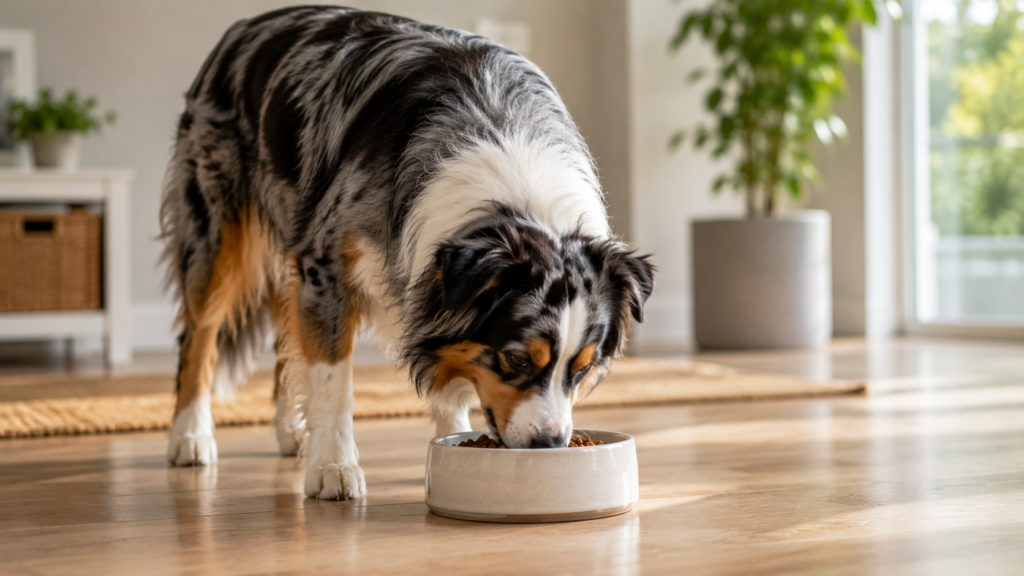
What should you look for in Australian Shepherd food?
There is no special Australian Shepherd nutrient profile and no universal protein or fat percentage that every Aussie needs.
For most owners, the better starting points are:
- A complete and balanced food appropriate for the dog’s life stage
- Enough calories to maintain a healthy body condition
- Appropriate portions for the dog’s real activity level
- A formula your individual dog digests and tolerates well
- Consistent feeding rather than frequent unnecessary food changes
An active breed label should not automatically push you toward the most calorie-dense or highest-protein food on the shelf.
Match the food to your Aussie’s actual workload
This is where Australian Shepherd owners should pay particular attention.
Two healthy adult Aussies of similar size can have very different energy requirements.
Companion or normally active Aussie
An Aussie getting regular walks, play, training, and everyday exercise may do perfectly well on a standard adult maintenance diet.
Do not assume that the breed’s working background means your dog needs performance food.
Watch body condition and weight over time, then adjust portions if needed.
Agility, herding, sport or working Aussie
Dogs doing substantial, repeated physical work may have higher energy demands.
Depending on workload, an appropriate performance-oriented diet or greater calorie intake may make sense.
The important variable is the work your dog is actually doing, not simply being an Australian Shepherd.
For dogs competing or working intensively, discuss calorie intake and conditioning with your veterinarian or a veterinary nutrition professional rather than relying on a breed-wide feeding rule.
Lower-activity Aussie
Activity can fall after an injury, schedule change, neutering, illness, or simply because an individual dog leads a quieter lifestyle.
If calorie intake remains unchanged while activity falls, weight can gradually increase.
Start by checking portions and body condition rather than assuming you need a completely different type of food.
Australian Shepherd puppy
Choose a food that is complete and balanced for growth.
Australian Shepherds are generally medium-sized dogs. A typical Aussie puppy should not automatically be treated as an AAFCO large-size puppy simply because larger breeds sometimes require specific growth formulas.
Growth should be steady rather than deliberately accelerated through overfeeding.
Your veterinarian can help you monitor weight and body condition as your puppy develops.
Older Aussie
Age alone does not tell you exactly what an older Australian Shepherd should eat.
Some remain highly active. Others slow down substantially.
Reassess calories as activity, body condition, muscle condition, appetite, dental health, or medical needs change.
A food labeled “senior” is not automatically necessary simply because your Aussie reaches a particular birthday.
Protein and fat: does an Australian Shepherd need more?
There is no evidence-based universal percentage of protein or fat that all Australian Shepherds require because of their breed.
Protein is essential, but “more” is not automatically better for every dog.
Fat increases the energy density of a diet and can be useful when a dog genuinely has high energy demands. The same calorie density can work against a less active dog if portions are not adjusted.
Instead of chasing a particular number on the bag, ask:
- Is the food appropriate for my dog’s life stage?
- Is my dog maintaining a healthy body condition?
- Is weight stable over time?
- Does the calorie density make sense for the workload?
- Is my dog tolerating the diet well?
Those answers are more useful than choosing food because it carries a “high protein” or “active breed” label.
Body condition matters more than feeding by breed stereotype
Australian Shepherds have recognized hip and elbow health concerns, which makes sensible weight management especially worthwhile.
That does not mean every Aussie needs a joint-support food or joint supplement.
It means avoiding unnecessary excess body weight is one practical thing owners can control.
You should generally be able to feel your dog’s ribs without having to press through a thick layer of fat, and there should be a visible waist when viewed from above.
The Aussie coat can make visual assessment harder, so use your hands as well as your eyes.
If you are unsure about your dog’s condition, ask your veterinarian to show you how to use a body condition score.
A simple feeding check for Australian Shepherd owners
Instead of relying indefinitely on the feeding chart printed on the bag:
- Measure your dog’s daily food
- Include treats and training rewards in the overall calorie picture
- Check body condition regularly
- Weigh your dog periodically
- Watch the weight trend rather than reacting to a single measurement
- Reassess portions when activity changes
- Make adjustments gradually
Feeding directions are useful starting estimates, not a personalized prescription.
For a dog doing frequent training, remember that small rewards can become a meaningful amount of food by the end of the day.
Using part of the regular food ration for training is one simple option when appropriate.
What about sensitive stomachs and food allergies?
Australian Shepherds should not be described as a breed that inherently has a sensitive stomach.
An individual Aussie can certainly develop digestive problems or an adverse reaction to food, just as other dogs can.
But chicken, beef, wheat, corn, or grains in general should not automatically be removed simply because your dog is an Australian Shepherd.
If your dog consistently develops diarrhea, vomiting, itching, recurrent ear or skin problems, weight loss, or other symptoms, the priority is determining the cause rather than cycling through increasingly restrictive foods.
If you suspect a food reaction
Keep the diet stable enough to identify patterns and record:
- What your dog eats
- Treats and chews
- Stool changes
- Vomiting
- Itching or skin changes
- When symptoms appear
A proper elimination diet for suspected food allergy is much more controlled than simply removing one ingredient for a week or two.
If symptoms are persistent or significant, work with your veterinarian on the appropriate diagnostic approach.
Should Australian Shepherds eat grain-free food?
There is no breed-specific reason to routinely feed Australian Shepherds a grain-free diet.
Grains are not inherently undesirable ingredients for an Aussie.
If a veterinary evaluation identifies a specific dietary reason to avoid an ingredient, the diet can be adjusted accordingly. Otherwise, “grain-free” should not be treated as a marker of superior food.
For most owners, nutritional adequacy, calorie suitability, individual tolerance, and the overall formulation matter more than whether grains appear on the ingredient list.
What about omega-3s, probiotics and joint ingredients?
These ingredients can be useful in the right context, but Australian Shepherd ownership alone is not a reason to automatically add them.
Omega-3 fatty acids
EPA and DHA can be useful nutritional components, and some complete foods already provide marine omega-3s.
Whether your dog needs additional supplementation depends on the diet and the individual reason for using it.
Probiotics
A probiotic is not a routine requirement for every Aussie.
If your dog has an ongoing gastrointestinal problem, finding the cause is more important than automatically adding a digestive supplement.
Joint-support ingredients
An active Aussie does not automatically need glucosamine, chondroitin, or another joint supplement.
Maintaining appropriate body condition, avoiding inappropriate excess calories during growth, and responding to actual mobility problems are more defensible priorities.
Dry, wet, fresh or another format?
There is no single food format that is inherently best for Australian Shepherds.
Dry food
Kibble can be convenient for measured portions, storage, and training.
The quality of the complete diet matters more than the fact that it is dry.
Wet food
Wet food can be fed as a complete diet when appropriately formulated or used alongside another food.
Check the label carefully: not every canned or pouched product is intended to provide complete daily nutrition.
Fresh food
Commercial fresh diets can also be appropriate when they are nutritionally complete and balanced for the intended life stage.
“Fresh” or “human-grade” wording by itself does not establish that a food is nutritionally superior.
Home-prepared diets
Home cooking requires more than combining meat, vegetables, and carbohydrates.
Long-term diets need the correct balance of essential nutrients.
If you want to feed a home-prepared diet as your dog’s primary food, use a properly formulated recipe from a veterinary nutrition professional rather than improvising one.
How to choose between two Australian Shepherd foods
Ignore the front-of-bag marketing for a moment.
Compare the foods using questions that matter:
- Is it complete and balanced for your dog’s life stage?
- How calorie-dense is it?
- Does that calorie density fit your dog’s workload?
- Can you feed an appropriate portion while maintaining body condition?
- Does your dog tolerate it consistently?
- Is the manufacturer transparent about nutritional formulation and quality control?
- Can you realistically buy and feed it consistently?
For an everyday companion Aussie, the most performance-focused formula is not automatically the better choice.
For an Aussie doing demanding work several times per week, calorie density may matter considerably more.
That is why a single universal “best Australian Shepherd food” ranking can be misleading.
Changing your Australian Shepherd’s food
Abrupt changes can cause digestive upset in many dogs, regardless of breed.
A gradual transition is usually easier to tolerate.
One practical approach is to increase the proportion of the new food over roughly a week while decreasing the old food.
Some dogs need a slower transition.
If significant vomiting, persistent diarrhea, blood in the stool, marked lethargy, loss of appetite, or other concerning symptoms appear, contact your veterinarian rather than assuming the transition is the only cause.
Common feeding mistakes to avoid
Feeding the breed instead of the individual
“Aussies are high-energy dogs” does not tell you how many calories your particular dog burns.
Use workload and body condition.
Increasing food automatically on busy days
One longer walk does not necessarily require a major increase in calories.
Look at sustained workload and weight trends rather than individual energetic days.
Letting training treats disappear from the calorie count
Australian Shepherds are highly trainable, and food rewards can accumulate quickly during frequent sessions.
Treats still count.
Changing foods every time stool quality changes
A single soft stool does not establish a food intolerance.
Repeated switching can make the original problem harder to interpret.
Assuming expensive or high-protein means better
Price, protein percentage, ingredient-list aesthetics, and breed imagery are poor substitutes for nutritional suitability.
Choose for the dog in front of you.
FAQ — Feeding an Australian Shepherd
What is the best food for an Australian Shepherd?
There is no single best food for every Aussie.
Look for a complete and balanced diet appropriate for life stage, then choose calorie density and portions based on your dog’s workload, body condition, weight trend, and individual tolerance.
Do Australian Shepherds need high-protein food?
Not simply because they are Australian Shepherds.
Protein needs must be met, but there is no universal breed-specific percentage that every Aussie should receive. A dog’s life stage and actual activity are more useful considerations.
How much should an Australian Shepherd eat?
There is no reliable breed-wide amount.
Start with the food’s feeding guidance, account for treats, and adjust according to body condition and weight trend.
Two Aussies at the same weight may need different calorie intakes if their activity differs substantially.
Should Australian Shepherd puppies eat large-breed puppy food?
Not automatically.
Australian Shepherds are generally medium-sized dogs, so a typical Aussie should not automatically be classified as a large-size dog for AAFCO growth requirements.
Choose a complete and balanced growth diet and discuss your puppy’s growth trajectory with your veterinarian if you have concerns.
Are Australian Shepherds prone to food sensitivities?
Individual Australian Shepherds can have adverse food reactions, but food sensitivity should not be treated as an established defining predisposition of the breed.
Do not remove chicken, beef, grains, or other ingredients solely because you own an Aussie.
Is grain-free food better for Australian Shepherds?
No breed-specific evidence makes grain-free food routinely preferable for Australian Shepherds.
Choose a diet based on nutritional adequacy and your individual dog’s needs rather than the absence of grains.
Does an active Aussie need performance dog food?
Sometimes, but not automatically.
A genuinely hard-working or sporting dog may benefit from greater energy density depending on workload. A normally active companion Aussie may have no need for a performance formula.
Next steps
For breed health information and the issues worth monitoring:
Australian Shepherd health guide
For training, enrichment, and everyday behavior guidance:
dog behaviour and training resources
For broader dog nutrition guidance:
dog nutrition guidance
Affiliate disclosure
Doglira may earn a commission from qualifying purchases made through links on this site, at no additional cost to you.
Recommendations are based on suitability and usefulness to the reader, not on whether a product offers an affiliate commission.