Australian Shepherds have several genuinely breed-relevant health concerns, but predisposition does not mean inevitability.
For this breed, some of the most useful health information exists before symptoms appear. Genetic testing can identify MDR1 drug sensitivity. Ophthalmic screening can detect inherited eye abnormalities. Hip and elbow evaluations matter in breeding programs. Family history remains important for conditions such as idiopathic epilepsy, where there is no equivalent simple predictive DNA test.
The strongest Australian Shepherd health picture is therefore not “joints, allergies, and sensitive digestion.”
It is genetics, screening, informed breeding, condition-specific awareness, and knowing when veterinary assessment matters.
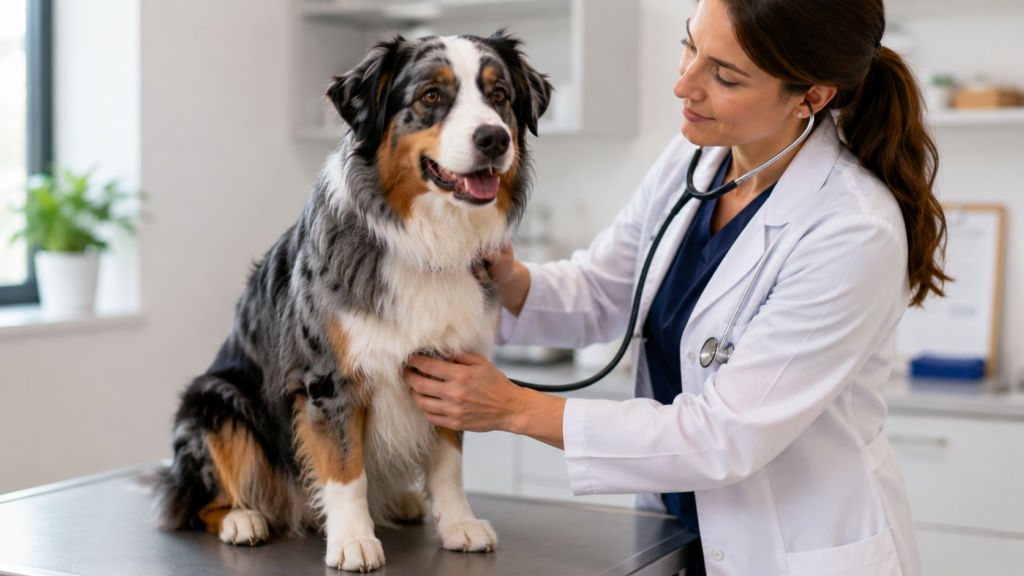
Australian Shepherd health at a glance
The main breed-relevant areas to understand are:
- MDR1 / ABCB1 medication sensitivity
- Inherited eye disease
- Idiopathic epilepsy
- Hip dysplasia
- Elbow dysplasia
- Merle and double-merle genetics
These conditions do not all work the same way.
Some have useful DNA tests.
Some require clinical screening.
Some depend heavily on family history.
Some can only be diagnosed after clinical signs develop.
Understanding those differences is more useful than simply asking whether a breeder says the parents are “health tested.”
MDR1 / ABCB1 drug sensitivity
MDR1 is one of the most actionable Australian Shepherd health issues because knowing the dog’s genotype can directly affect medication decisions.
The underlying variant occurs in the ABCB1 gene, historically referred to as MDR1.
ABCB1 normally helps produce P-glycoprotein, a transporter involved in limiting the movement of certain substances into tissues including the brain.
In affected dogs, altered transporter function can increase sensitivity to certain medications.
Not every Australian Shepherd carries the mutation, and reported frequencies vary substantially between populations.
What an MDR1 result means
Dogs inherit two copies of the gene.
For the known MDR1 mutation, testing can identify dogs with:
- Two normal copies
- One mutated copy
- Two mutated copies
Dogs with two mutated copies generally have the greatest susceptibility, but dogs with one copy may also have altered sensitivity to some drugs.
That means “carrier” should not automatically be interpreted as clinically irrelevant.
Why MDR1 matters when medications are prescribed
Several medication classes can create greater toxicity risk in genetically susceptible dogs.
Examples can include certain exposures to:
- Ivermectin and related drugs
- Loperamide
- Some sedative or anesthetic drugs
- Some chemotherapy medications
This should not be converted into a homemade medication blacklist.
Risk depends on the specific medication, dose, genotype, and clinical context.
It is also incorrect to tell owners that an Australian Shepherd can never receive common parasite preventives simply because MDR1 exists in the breed.
The practical rule is much simpler:
Know the genotype when possible and make sure the veterinarian prescribing or administering medication knows it too.
Should your Australian Shepherd be tested for MDR1?
Testing can be useful because the mutation is established in the breed and the result may inform future veterinary drug decisions.
If your dog has already been tested:
- Keep the result with the medical records
- Tell your regular veterinarian
- Mention it to emergency hospitals and specialists
- Provide the result when a new clinician may prescribe medication
A positive test does not mean the dog is currently sick.
A normal result also does not guarantee that the dog can never experience an adverse medication reaction.
Signs of a potentially serious drug reaction
Depending on the medication and exposure, concerning neurological signs can include:
- Unexpectedly profound sedation
- Disorientation
- Loss of coordination
- Tremors
- Seizures
- Collapse
Significant neurological changes after medication exposure warrant prompt veterinary contact, with emergency evaluation when signs are severe.
Do not stop, reduce, increase, or substitute prescribed medication without veterinary guidance.
Inherited eye disease deserves substantial attention
Australian Shepherds have several inherited ocular conditions rather than one universal “Aussie eye disease.”
That distinction is important because different diseases have different genetics, effects on vision, and screening methods.
Responsible breeding programs therefore use both clinical ophthalmic examination and condition-specific genetic testing where appropriate.
Hereditary cataract and HSF4
An HSF4 variant is strongly associated with hereditary cataract risk in Australian Shepherds.
But HSF4 does not explain every inherited cataract in the breed.
An HSF4-clear dog should therefore not be described as “cataract-proof.”
Owner-noticed changes can include:
- Lens cloudiness
- Increasing difficulty seeing
- Bumping into objects
- Reluctance in unfamiliar environments
Cataracts can also begin before substantial vision changes become obvious at home.
That is one reason clinical eye screening remains useful even when genetic testing has been performed.
Collie Eye Anomaly
Collie Eye Anomaly, or CEA, is another established inherited condition in Australian Shepherds.
Its severity varies.
Some affected dogs can retain useful or apparently normal vision, while more severe disease can involve retinal complications and significant vision loss.
CEA should not be reduced to:
“An affected Aussie will go blind.”
That is not true for every affected dog.
PRA and other inherited eye disorders
Progressive retinal atrophy also occurs in Australian Shepherds, alongside other recognized ocular abnormalities such as colobomas and multifocal retinal disease.
There is little value in turning this page into a catalogue of every possible eye diagnosis.
The important owner lesson is that multiple inherited eye problems occur in the breed, which is why one genetic result cannot replace examination of the actual eyes.
DNA testing and an ophthalmologist exam are not interchangeable
These tools answer different questions.
A DNA test looks for a specific known genetic variant.
A veterinary ophthalmologist examines the eyes themselves for detectable abnormalities.
One cannot universally replace the other.
This matters particularly in Australian Shepherds because:
- Multiple different inherited eye diseases occur
- Not every ocular disorder is captured by one genetic test
- Some disorders can become apparent clinically later
- A clear result for one variant says nothing about unrelated eye diseases
Home observation is useful for noticing changes.
It is not hereditary-eye screening.
Hip and elbow dysplasia
Hip and elbow dysplasia are established Australian Shepherd health-screening concerns.
That does not mean either condition should automatically be described as extremely common in the breed.
Screening relevance and population prevalence are not the same thing.
Hip dysplasia
Hip dysplasia has a genetic component and is multifactorial.
Growth, environment, body condition, and other factors can influence how the condition develops or affects an individual dog.
What should not be said is:
“Australian Shepherds get hip dysplasia because they exercise too much.”
Normal breed activity is not a simple cause of an inherited developmental orthopedic disorder.
Possible signs of hip or other hindlimb problems include:
- Lameness
- Stiffness
- Difficulty rising
- Reluctance to jump
- Reduced willingness to exercise
- Discomfort
- Altered gait
These signs are nonspecific.
They do not diagnose hip dysplasia.
Veterinary assessment may involve an orthopedic examination and imaging.
Elbow dysplasia
Elbow dysplasia is also important enough to be part of formal Australian Shepherd breeding-screening recommendations.
Potential signs can include:
- Forelimb lameness
- Stiffness
- Discomfort
- Changes in gait or activity
Again, those signs can have many causes.
Diagnosis belongs to the veterinarian.
What about “joint strain” from being an active breed?
Being athletic does not create a distinct Australian Shepherd disease called “joint strain.”
It is more useful to separate:
- Hip dysplasia
- Elbow dysplasia
- Acute injuries
- Overuse injuries
- Conditioning problems
- Other orthopedic disease
Active Aussies should be conditioned progressively, and workload should fit age, fitness, and orthopedic health.
That is very different from claiming that the breed develops dysplasia because it runs or works.
Body condition still matters
Maintaining an appropriate body condition supports general and orthopedic health.
That does not require describing Australian Shepherds as an obesity-prone breed.
Detailed feeding and calorie decisions belong in:
Australian Shepherd food guide
Idiopathic epilepsy in Australian Shepherds
Idiopathic epilepsy has meaningful breed-specific evidence in Australian Shepherds and appears to have a genetic component.
Research in affected Aussies has also shown that severe seizure patterns can occur in some individuals.
But affected-dog studies cannot tell us that most Australian Shepherds will develop epilepsy or that every affected dog will have severe disease.
What a seizure can look like
Generalized seizure activity may involve:
- Sudden loss of responsiveness or consciousness
- Collapse
- Body stiffening
- Rhythmic limb movements or paddling
- Jaw movements
- Salivation
- Involuntary urination or defecation in some events
- Confusion or disorientation afterward
Not every unusual movement is a seizure.
A single vague sign such as staring is too nonspecific to use as a diagnosis.
What to record if your dog has a seizure
If it is safe to do so:
- Time the event
- Record how long it lasts
- Note whether more than one seizure occurs
- Video the episode if possible
- Note what recovery looks like afterward
- Record previous similar episodes
- Tell the veterinarian about recent medications or possible toxin exposure
This information can be much more useful than trying to interpret the event yourself.
When a seizure becomes an emergency
A seizure lasting around five minutes or longer is an emergency concern.
Repeated seizures without full recovery between them also warrant emergency veterinary attention.
Severe or recurrent seizure activity should likewise be treated urgently.
A first-ever seizure deserves veterinary assessment even if the dog appears to recover normally afterward.
Do not administer unprescribed anticonvulsant medication.
Is there an epilepsy DNA test for Australian Shepherds?
There is no simple routine predictive test that plays the same role for idiopathic epilepsy that MDR1 testing does for drug sensitivity.
That makes family history particularly important in breeding decisions.
A clear result on an unrelated genetic panel does not establish that a dog cannot develop idiopathic epilepsy.
Merle is normal; double-merle inheritance is the health issue
Merle is a normal Australian Shepherd coat pattern.
The presence of merle coloration alone does not mean a dog is unhealthy.
The important medical distinction involves dogs inheriting merle variants from both parents in combinations that produce a high-risk double-merle phenotype.
Double-merle inheritance substantially increases the risk of congenital hearing and eye abnormalities.
Double merle does not mean every dog is blind and deaf
Risk is increased.
Outcome is not identical in every puppy.
Some double-merle dogs can have significant hearing impairment, eye abnormalities, or both.
The severity varies.
Avoid absolute claims such as:
- Every double merle is deaf
- Every double merle is blind
- Every merle Aussie has eye disease
Blue eyes are not a diagnosis
Blue eyes occur normally in Australian Shepherds.
Eye color alone does not establish deafness or inherited ocular disease.
Cryptic and hidden merle
Merle genetics can be more complicated than coat appearance suggests.
Some variants may produce little obvious visible merling, which can complicate breeding decisions.
For pet owners, the essential point is simply that responsible merle breeding may require genetic knowledge rather than relying only on what each parent looks like.
When BAER testing is relevant
BAER testing objectively evaluates auditory function.
It can be useful when congenital deafness is suspected or in breeding contexts involving increased pigment-associated hearing risk.
It should not be presented as a universal mandatory test for every Australian Shepherd puppy.
Other inherited conditions exist, but not every DNA result deserves equal billing
Australian Shepherd genetic panels can identify or report several other variants.
Examples can include genes associated with:
- Degenerative myelopathy
- Canine multifocal retinopathy
- Progressive retinal atrophy
- Inherited intestinal cobalamin malabsorption
- Other breed-recognized disorders
That does not mean all of them carry the same clinical importance for every dog.
The existence of a test should not automatically become:
“This is one of the major Australian Shepherd health problems.”
Penetrance, disease severity, prevalence, inheritance, and the usefulness of the result all matter.
A rare digestive disorder does not make Aussies a sensitive-stomach breed
Inherited intestinal cobalamin malabsorption is a real genetic condition recognized in the breed.
It should not be used to revive the idea that Australian Shepherds generally have sensitive digestion.
A specific inherited absorption disorder and everyday soft stools are not the same thing.
What about allergies?
Individual Australian Shepherds can develop allergic or dermatologic disease.
Current evidence does not justify making allergy one of the defining breed-health pillars or claiming that Aussies commonly react to chicken, beef, wheat, or grains.
Persistent skin disease deserves veterinary evaluation.
It does not automatically require changing proteins or buying a specialized diet.
Australian Shepherd health screening and responsible breeding
This is one of the most important sections for prospective owners.
Health testing is most useful when you know what was actually tested, how it was tested, and what the result means.
“Health tested” by itself tells you very little.
Core screening to ask about
Current US breed-club/AKC recommendations emphasize:
- Hip evaluation
- Elbow evaluation
- Ophthalmologist evaluation
These deserve particular attention when evaluating breeding dogs.
Ask to see records rather than accepting verbal reassurance that everything was checked.
Where DNA tests fit
Depending on the breeder, pedigree, and testing strategy, genetic testing may include variants related to conditions such as:
- MDR1 / ABCB1
- HSF4-associated hereditary cataract
- CEA
- PRA and other inherited disorders
DNA testing can be extremely useful.
It is not the same thing as hip imaging, elbow evaluation, or examination by a veterinary ophthalmologist.
Why family history still matters
Some important diseases do not have a simple predictive DNA test.
Idiopathic epilepsy is a prime example.
A breeder cannot simply show an “epilepsy clear” DNA certificate equivalent to an MDR1 result.
That makes honest discussion of affected relatives and broader family history valuable.
What does a CHIC number mean?
A CHIC number is useful evidence that the breed-specific testing requirements were completed and results were made publicly available.
It does not mean every test result was normal.
That distinction is important.
Look at the actual results.
Do not stop at the presence of the number.
Screening reduces uncertainty; it does not guarantee a healthy puppy
Even excellent screening cannot guarantee:
- No future epilepsy
- No later cataracts
- No orthopedic disease
- No acquired illness
- Perfect health throughout life
Testing helps identify known risks and avoid some predictable high-risk breeding combinations.
It is risk management, not a lifetime warranty.
DNA testing, clinical screening, and diagnosis are different things
These terms are easy to blur together.
DNA testing
Looks for a known genetic variant.
It can sometimes identify risk before symptoms exist.
Examples include MDR1 and CEA testing.
Clinical screening
Examines the dog for measurable evidence of disease or abnormal structure.
Examples include:
- Hip evaluation
- Elbow evaluation
- Veterinary ophthalmologist examination
Diagnostic testing
Investigates a dog because illness or clinical signs are suspected.
A dog limping on a walk, having a seizure, or suddenly losing vision is no longer a breeding-screening question.
It is a veterinary diagnostic question.
What Australian Shepherd owners should keep track of
You do not need a rigid daily or monthly health calendar.
A few high-value habits are more useful:
- Know MDR1 status if the dog has been tested
- Keep genetic and screening records
- Share relevant genetic results with veterinarians
- Seek assessment for unexplained seizures
- Take meaningful vision changes seriously
- Investigate persistent lameness or mobility changes
- Maintain an appropriate body condition
- Keep up with normal preventive veterinary care
- Understand the health testing behind your dog’s pedigree when possible
For prospective owners, ask breeders specifically about:
- Hips
- Elbows
- Ophthalmologist evaluation
- Relevant DNA testing
- Epilepsy and family history
- Merle mating decisions where relevant
Ask for documentation.
When to call a veterinarian
Seek urgent or emergency care for:
- A seizure lasting around five minutes or longer
- Repeated seizures without full recovery
- Severe or recurrent seizure activity
- Sudden vision loss
- Collapse
- Severe neurological changes after medication exposure
- Severe sedation, tremors, or seizures after medication exposure
- Non-weight-bearing lameness
- Severe pain
- Sudden major loss of mobility
Arrange veterinary assessment for:
- A first-ever seizure
- Persistent mild lameness or stiffness
- Gradual vision changes
- Recurrent neurological episodes
- Persistent skin disease
- Other ongoing changes that do not resolve
These signs can have many possible causes.
This guide can help you understand why certain problems matter in Australian Shepherds, but it cannot diagnose the individual dog.
FAQ — Australian Shepherd health
What health problems are Australian Shepherds prone to?
The most important evidence-supported areas include MDR1/ABCB1 medication sensitivity, inherited eye diseases, idiopathic epilepsy, recognized hip and elbow screening concerns, and the congenital sensory risks associated with double-merle inheritance.
None of those risks means every Australian Shepherd will be affected.
What is MDR1 in Australian Shepherds?
MDR1 commonly refers to a mutation in the ABCB1 gene that can change sensitivity to certain medications.
A DNA test can identify the known mutation.
Knowing the result can help veterinarians make safer drug decisions for the individual dog.
Should Australian Shepherds be tested for MDR1?
MDR1 testing can be useful because the mutation is established in the breed and the result may influence medication choices.
If your Aussie has been tested, keep the result in its veterinary records.
What health tests should Australian Shepherd breeders perform?
Current core US breed-club recommendations include:
- Hip evaluation
- Elbow evaluation
- Ophthalmologist evaluation
Additional genetic testing can be useful depending on the condition and breeding program.
Ask for the actual records rather than only asking whether the dogs are “health tested.”
Are Australian Shepherds prone to eye problems?
Several inherited eye disorders are established in the breed, including hereditary cataract and Collie Eye Anomaly.
Clinical ophthalmic screening remains important because no single DNA test covers the entire inherited-eye risk landscape.
Are Australian Shepherds prone to epilepsy?
Idiopathic epilepsy is a recognized breed-health concern with evidence supporting a genetic component.
That does not establish that epilepsy is common across the entire Australian Shepherd population or that every affected dog will have severe disease.
Should Australian Shepherds have hip and elbow screening?
Formal hip and elbow evaluation is particularly relevant for breeding dogs and forms part of current breed health-screening recommendations.
Screening importance should not be confused with saying that every Australian Shepherd is highly likely to develop dysplasia.
Is merle unhealthy in Australian Shepherds?
No.
Single merle is a normal Australian Shepherd coat pattern.
The major health concern involves double-merle inheritance, which substantially increases the risk of congenital hearing and eye abnormalities.
What does double merle mean?
A double-merle dog has inherited merle-related genetic material from both parents in a combination capable of producing the double-merle phenotype.
These dogs have increased risk of congenital hearing and eye abnormalities.
That does not mean every double-merle dog has identical impairment.
More Australian Shepherd guides
For the complete Australian Shepherd breed and ownership guide:
complete Australian Shepherd breed and ownership guide
For detailed feeding and food-selection guidance: