Staffordshire Bull Terriers are not inherently unhealthy dogs, but the breed does have several health concerns that deserve specific attention.
The strongest Staffy health picture is not the old combination of sensitive digestion, food reactions, joint wear, and supplement recommendations.
It is much more specific: documented atopic dermatitis risk, a strong juvenile demodicosis signal, the inherited neurologic disease L-2-HGA, hereditary cataract associated with HSF4, congenital eye abnormalities such as PHPV/PHTVL, and a formal screening framework that includes hips, elbows, ophthalmologist examination, and DNA testing.
These conditions do not all work the same way.
Some are diagnosed clinically.
Some have useful DNA tests.
Some require imaging or specialist examination.
And a dog can pass several health tests without being guaranteed perfect health for life.
The useful goal is to understand the real breed risks, know what individual tests actually tell you, recognize meaningful changes, and involve a veterinarian when clinical signs appear.
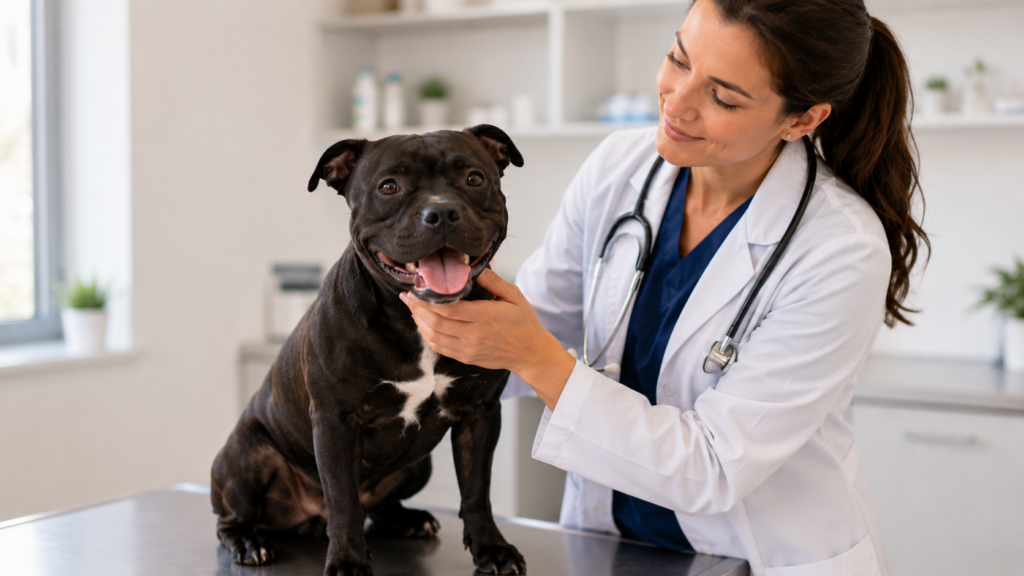
Staffordshire Bull Terrier health at a glance
The main breed-relevant health areas worth understanding are:
- Atopic dermatitis
- Juvenile-onset demodicosis
- L-2-Hydroxyglutaric Aciduria (L-2-HGA)
- HSF4 hereditary cataract
- PHPV/PHTVL and other ophthalmic abnormalities
- Hip dysplasia screening
- Elbow dysplasia screening
- Cranial cruciate ligament disease
The breed’s health-testing structure is also unusually important.
Current core Staffy testing combines:
- Hip evaluation
- Elbow evaluation
- Ophthalmologist examination
- L-2-HGA DNA testing
- Hereditary-cataract DNA testing
That combination illustrates an important principle:
DNA testing and clinical screening answer different health questions.
Atopic dermatitis and skin disease in Staffordshire Bull Terriers
Staffordshire Bull Terriers have a documented predisposition to canine atopic dermatitis.
In a large UK primary-care study, Staffies had higher odds of atopic dermatitis than non-Staffies.
That supports genuine breed relevance.
It does not mean most Staffies will develop allergies or that skin disease is inevitable.
What atopic dermatitis can look like
Possible signs include:
- Persistent itching
- Licking or chewing the paws
- Face rubbing
- Red or inflamed skin
- Recurrent secondary skin infections
- Recurring ear inflammation in some dogs
These signs are not diagnostic by themselves.
A Staffy with itching may have atopic dermatitis, flea allergy, food allergy, infection, parasites, or another dermatologic problem.
Atopy is not the same thing as food allergy
This distinction is particularly important in Staffies because breed-level evidence for atopic dermatitis is sometimes turned into unsupported food advice.
Atopic dermatitis and food allergy can produce overlapping skin signs.
That does not mean an itchy Staffy is probably reacting to its diet.
There is no sound Staffy-specific basis for automatically removing:
- Chicken
- Beef
- Wheat
- Corn
- Grains
because of breed.
Likewise, switching every itchy Staffy to salmon, lamb, grain-free food, or a limited-ingredient commercial diet does not diagnose the underlying problem.
Food-allergy investigation belongs in a controlled veterinary diagnostic process.
Detailed food-selection guidance belongs in:
Staffordshire Bull Terrier food guide
Environmental allergy can be part of the picture
Atopic dermatitis commonly involves environmental allergens and complex interactions between the immune system and skin barrier.
Some dogs may flare seasonally.
Others have signs throughout the year.
Do not assume spring or summer itching is an intrinsic Staffy pattern.
Juvenile-onset demodicosis deserves more attention than generic “hot spots”
Staffordshire Bull Terriers have a strong documented association with juvenile-onset demodicosis.
Large studies in both the US and UK have found markedly increased risk in young Staffies.
That makes juvenile demodicosis a much more meaningful breed-specific dermatology concern than vague claims about dry skin or sensitive skin.
Possible signs include:
- Localized or multifocal hair loss
- Redness
- Scaling
- Comedones
- More extensive inflammation
- Secondary bacterial infection in severe generalized disease
The strongest breed association is with juvenile-onset disease.
An adult Staffy with hair loss should not automatically be assumed to have demodicosis.
Is juvenile demodicosis inherited?
There is recognized hereditary and immune-susceptibility context, particularly for generalized juvenile disease.
That does not mean there is one simple Staffy DNA test that labels a dog clear or affected.
Clinical veterinary evaluation remains necessary.
Recurring ear disease
Ear inflammation can accompany allergic skin disease.
Owners may notice:
- Odor
- Redness
- Head shaking
- Scratching
- Discharge
- Pain
But recurring otitis does not automatically prove allergy.
Infection, foreign material, anatomy, and other inflammatory conditions can also contribute.
Repeated ear disease deserves veterinary examination rather than a universal weekly-cleaning routine.
Secondary skin infection
Atopic dermatitis and generalized demodicosis can both create conditions in which secondary bacterial skin infection develops.
That is better understood as a complication of underlying skin disease than as a separate inherited Staffy condition.
Markedly painful, spreading, infected skin disease or systemic illness deserves prompt veterinary assessment.
L-2-Hydroxyglutaric Aciduria (L-2-HGA)
L-2-HGA is one of the clearest genuinely Staffordshire Bull Terrier-specific inherited diseases.
Its full name is L-2-Hydroxyglutaric Aciduria.
It is an inherited neurometabolic disorder involving the L2HGDH gene and is transmitted in an autosomal-recessive manner.
“Metabolic” in this context does not mean:
- Food intolerance
- Digestive sensitivity
- A requirement for special metabolic food
- A vitamin or supplement deficiency
L-2-HGA is fundamentally a neurologic genetic disease.
What signs can L-2-HGA cause?
Clinical presentation can vary.
Reported signs include:
- Abnormal gait
- Generalized stiffness
- Abnormal spinal posture
- Head or body tremors
- Exaggerated limb movement
- Behavioral or cognitive changes
- Staring episodes
- Apparent loss of previously learned behavior
- Paroxysmal movement abnormalities
- Seizures
It is misleading to reduce L-2-HGA to simply “a seizure disease.”
Gait dysfunction, stiffness, tremors, and behavioral abnormalities can be major components.
When does L-2-HGA appear?
Affected Staffies can develop signs when young, but there is no single age that applies to every dog.
In one Staffy-specific clinical study, onset ranged from early puppyhood into adulthood.
The disease is considered progressive, but progression can vary considerably between individuals.
How is L-2-HGA diagnosed?
Clinical investigation can involve:
- Neurologic examination
- MRI
- Organic-acid analysis
- DNA testing
For prospective owners and breeders, DNA status is the most actionable screening information.
For a dog already showing neurological abnormalities, however, a DNA result does not replace clinical assessment.
Clear, carrier and affected
Because L-2-HGA is autosomal recessive, DNA results for the known disease-associated variant can generally be interpreted as:
Clear:
- No tested disease-associated copies
Carrier:
- One disease-associated copy
- Typically not clinically affected by the recessive disorder
- Can transmit the variant to offspring
Affected or genetically at risk:
- Two disease-associated copies
- Genetically compatible with development of L-2-HGA
A DNA result identifies genetic status for the tested mutation.
It does not tell you:
- Current neurologic severity
- Exact age of onset
- Exact progression
- Which specific symptoms an affected dog will develop
A Staffy seizure does not automatically mean L-2-HGA
Seizures have many possible causes.
One large Staffy primary-care study also found increased seizure-disorder odds, although Staffy case numbers were relatively limited.
L-2-HGA is an important breed-specific differential diagnosis.
It is not the explanation for every Staffy seizure.
A first seizure, repeated seizures, prolonged seizure activity, or significant neurological deterioration warrants veterinary evaluation.
Can L-2-HGA be cured?
There is no simple curative genetic treatment in routine veterinary practice.
Clinical signs may sometimes be managed symptomatically.
The course varies between dogs, so neither of these statements is justified:
“L-2-HGA is always a fatal puppy disease.”
or:
“Treatment guarantees a normal lifespan.”
Eye disease in Staffordshire Bull Terriers
Eye health is another area where Staffordshire Bull Terriers have unusually useful genetic and clinical screening information.
The key distinction is between:
- A DNA test for a specific inherited mutation
- Examination of the actual eyes by a veterinary ophthalmologist
Both have value because they answer different questions.
HSF4 hereditary cataract
Staffordshire Bull Terriers have a well-established autosomal-recessive form of hereditary cataract associated with HSF4.
This is significant enough that hereditary-cataract DNA testing forms part of current Staffy health-testing recommendations.
For this specific mutation:
Clear:
- No tested mutation copies
Carrier:
- One copy
- Not considered clinically affected simply because one recessive copy is present
- Can transmit the mutation
Affected or genetically at risk:
- Two copies
What owners may notice
Cataract-related changes can include:
- Visible lens cloudiness
- Difficulty seeing
- Bumping into objects
- Increasing difficulty navigating unfamiliar spaces
Some ocular abnormalities can also be detected during specialist examination before owners notice meaningful visual impairment.
HSF4-clear does not mean cataract-proof
Not every cataract that can occur in a Staffordshire Bull Terrier is necessarily caused by the known HSF4 mutation.
Therefore:
A clear HSF4 DNA result answers one important hereditary-cataract question.
It does not guarantee that a Staffy can never develop any cataract or other eye disease.
PHPV/PHTVL
PHPV/PHTVL refers to persistent fetal vascular tissue inside the eye that failed to regress normally during development.
It is a recognized congenital ocular abnormality in Staffordshire Bull Terriers.
Severity varies considerably.
Mild cases may have limited functional impact.
More substantial abnormalities can involve:
- Cataract
- Structural eye abnormalities
- Reduced vision
There is not an equivalent routine Staffy DNA test for PHPV/PHTVL.
That makes clinical ophthalmologist examination particularly important.
Why a DNA test cannot replace an eye exam
The hereditary-cataract DNA test checks for a particular known HSF4 mutation.
An ophthalmologist assesses the dog’s actual ocular phenotype.
That examination can identify abnormalities not represented by the DNA result, including PHPV/PHTVL and other eye disease.
A useful rule is:
HSF4 testing answers one cataract question, not every future eye question.
Orthopedic health in Staffordshire Bull Terriers
Orthopedic health deserves a screening-led rather than stereotype-led approach in Staffies.
The breed’s muscular appearance should not be used to claim that Staffies “wear out their joints” through normal activity.
Hip and elbow evaluation are formal health-screening priorities.
Cranial cruciate ligament disease also has breed-specific epidemiological support.
Hip dysplasia
Hip dysplasia is a developmental, multifactorial orthopedic condition with genetic and environmental influences.
Hip evaluation is a core Staffy health-screening priority.
That does not prove that hip dysplasia is extremely common in the entire pet Staffy population.
Possible signs include:
- Hindlimb lameness
- Stiffness
- Difficulty rising
- Reluctance to jump
- Changes in gait
- Reduced willingness to exercise
Some dogs with radiographic abnormalities may show relatively few clinical signs.
Does exercise cause hip dysplasia?
Normal activity does not simply create inherited hip dysplasia.
Avoid claims such as:
“Staffies damage their hips because they sprint.”
or:
“Muscular Staffies wear their hips out.”
A dog’s growth, genetics, conditioning, body condition, injuries, and other factors all matter.
Elbow dysplasia
Elbow evaluation is also part of the core Staffordshire Bull Terrier screening framework.
Possible clinical signs include:
- Forelimb lameness
- Stiffness
- Pain
- Difficulty exercising
- Reduced joint movement
Again, screening importance does not prove high population prevalence.
Formal evaluation matters because an apparently sound dog can still have structural abnormalities relevant to breeding decisions.
Cranial cruciate ligament disease
Staffordshire Bull Terriers have shown increased odds of cranial cruciate ligament, or CCL, disease in UK primary-care epidemiology.
Use CCL rather than ACL when referring to canine anatomy.
Possible signs include:
- Acute hindlimb lameness
- Progressive hindlimb lameness
- Reluctance to bear weight
- Stiffness
- Difficulty rising
The evidence supports a breed association.
It does not support the old explanation that Staffies rupture their cruciate ligaments because they are “explosive athletes.”
Osteoarthritis
Osteoarthritis can develop secondary to:
- Hip or elbow dysplasia
- CCL disease
- Previous injury
- Aging
- Other joint disease
It is useful as downstream orthopedic context.
It should not be presented as a defining inherited Staffy disease or inevitable consequence of being active.
What about luxating patellas?
Patellar luxation is a useful example of why screening menus and actual breed predisposition are not the same thing.
Optional patellar screening exists in Staffy health programs.
However, large UK primary-care data found Staffordshire Bull Terriers at reduced rather than increased risk of patellar luxation.
So it should not be presented as one of the breed’s major health problems.
Body condition and orthopedic load
Staffies should not automatically be described as obesity-prone.
Current breed-specific evidence does not justify that stereotype.
Appropriate body condition still matters.
Excess body mass can add unnecessary mechanical load, particularly in a dog with existing orthopedic disease.
Detailed calorie, portion, and weight-management guidance belongs in:
Staffordshire Bull Terrier food guide
Staffordshire Bull Terrier health testing and responsible breeding
Health testing is one of the strongest owner-education opportunities for this breed.
Current core Staffy testing combines DNA tests and phenotype-based screening because not every condition can be evaluated in the same way.
The core current testing stack includes:
- Hip evaluation
- Elbow evaluation
- Ophthalmologist examination
- L-2-HGA DNA test
- Hereditary-cataract DNA test
Why these tests are different
L-2-HGA DNA testing asks:
Does this dog carry the known disease-associated genetic variant?
HSF4 testing asks:
What is this dog’s genetic status for the known recessive hereditary-cataract mutation?
Ophthalmologist examination asks:
What abnormalities are actually present in the eyes?
Hip and elbow evaluations ask:
What does the dog’s orthopedic structure show on formal assessment?
These are different questions.
One type of screening cannot substitute for every other type.
DNA testing before a dog looks sick
DNA testing can identify inherited status before clinical disease appears.
That is particularly useful with Staffies because two important breed diseases — L-2-HGA and HSF4 hereditary cataract — have actionable genetic tests.
But a DNA result does not mean:
“This dog has been checked for every Staffordshire Bull Terrier disease.”
What does clear by parentage mean?
Breed health programs may recognize “clear by parentage” for conditions such as L-2-HGA and hereditary cataract when documented parental genetic results make the inheritance status clear.
If a breeder says a puppy is clear by parentage, ask to see the underlying documentation.
Do not treat the phrase itself as proof.
Ophthalmologist examination
Clinical ophthalmic examination remains important even when both parents have DNA results.
It can identify ocular abnormalities that the HSF4 test does not cover, including PHPV/PHTVL.
This is one of the clearest examples of why a large DNA panel does not replace physical or specialist screening.
Hip and elbow results
Ask for actual hip and elbow screening results rather than accepting:
“The parents move well.”
or:
“They’ve never had joint problems.”
A clinically athletic dog can still have structural findings relevant to breeding.
Optional tests
Some Staffy health programs also include optional evaluations such as:
- Cardiac screening
- Patella evaluation
Optional availability should not be interpreted as proof that those conditions are major Staffordshire Bull Terrier predispositions.
Screening programs exist to improve information, not to create a ranked list of breed diseases.
Ask for actual records
Useful questions include:
- Can I see the L-2-HGA results for both parents?
- Can I see the hereditary-cataract HSF4 results?
- If a dog is clear by parentage, can I see the supporting documentation?
- Can I see ophthalmologist examination results?
- Were the parents assessed for PHPV/PHTVL?
- Can I see hip results?
- Can I see elbow results?
- Are optional tests relevant to this pedigree?
- What major diseases have appeared in parents, siblings, or older relatives?
- What were the known causes and ages of death in close relatives?
- Can the screening results be independently verified?
That is much more useful than asking only:
“Are the parents health tested?”
What health testing cannot guarantee
Health testing can:
- Identify specific inherited variants
- Assess actual eye phenotype
- Evaluate hips and elbows
- Improve breeding decisions
- Reduce uncertainty
It cannot guarantee:
- Lifelong health
- No acquired disease
- No unrelated eye disease
- No dermatologic disease
- No orthopedic injury
- Perfectly healthy offspring
- That every possible Staffy condition has been excluded
A Staffy with clear DNA tests and normal screening results has useful documented health information.
It does not come with a lifetime medical guarantee.
What Staffy owners should monitor
You do not need a rigid daily, weekly, or monthly health tracker.
More useful priorities include:
- Investigate persistent or recurrent itching
- Take juvenile hair loss, scaling, or inflammation seriously
- Seek assessment for recurring painful ear disease
- Notice gait changes, stiffness, tremors, or unusual neurological behavior
- Take seizures seriously without assuming the cause
- Watch for lens cloudiness or visual changes
- Investigate persistent lameness
- Maintain appropriate body condition
- Keep genetic and screening results in the dog’s records
- Maintain normal preventive veterinary care
When to seek veterinary care
Seek urgent or emergency assessment for:
- A prolonged seizure
- Repeated seizures or seizure clusters
- Severe loss of coordination
- Collapse
- Major acute neurological deterioration
- A suddenly painful or markedly red eye
- Sudden loss of vision
- Severe non-weight-bearing lameness
- Major acute pain
- Severe facial swelling
- Difficulty breathing
- Severe spreading or infected skin disease with systemic illness
- Severe ear pain with marked head tilt or balance abnormalities
A Staffy’s breed history can make particular diagnoses worth considering.
It cannot tell you the diagnosis from the sign alone.
Arrange veterinary assessment for:
- Persistent itching
- Recurrent paw licking or skin inflammation
- Juvenile hair loss or scaling
- Recurring ear inflammation
- Progressive gait or stiffness changes
- Tremors
- Behavioral or cognitive changes
- Persistent lameness
- Gradual vision changes
- New lens cloudiness
FAQ — Staffordshire Bull Terrier health
What health problems are Staffordshire Bull Terriers prone to?
Important breed-relevant concerns include atopic dermatitis, juvenile-onset demodicosis, L-2-HGA, hereditary cataract associated with HSF4, PHPV/PHTVL, and recognized orthopedic screening concerns involving hips and elbows.
Staffies have also shown increased cranial cruciate ligament disease risk in primary-care research.
None of these conditions affects every Staffordshire Bull Terrier.
What is L-2-HGA in Staffies?
L-2-Hydroxyglutaric Aciduria is an inherited autosomal-recessive neurometabolic disorder associated with L2HGDH.
It can produce gait abnormalities, stiffness, tremors, behavioral changes, abnormal movement episodes, and seizures.
A DNA test can identify genetic status for the known Staffy disease-associated variant.
Should Staffordshire Bull Terriers be tested for L-2-HGA?
L-2-HGA DNA testing is part of current core Staffordshire Bull Terrier health-testing recommendations.
It is particularly useful for breeding decisions because the condition is autosomal recessive.
Are hereditary cataracts common in Staffies?
A specific recessive form of hereditary cataract associated with HSF4 is well established in Staffordshire Bull Terriers and important enough to warrant DNA testing.
That does not establish one universal population prevalence or mean every Staffy cataract is caused by HSF4.
Are Staffies prone to skin allergies?
Staffordshire Bull Terriers have documented increased risk of atopic dermatitis compared with non-Staffies in large UK primary-care research.
That does not mean most Staffies have allergies or that itching is automatically food-related.
Is atopic dermatitis the same as food allergy?
No.
Atopic dermatitis and food allergy can produce overlapping skin signs, but they are not the same diagnosis.
Staffy breed predisposition to atopy does not establish chicken, beef, grains, or another ingredient as routine breed allergens.
Are Staffies prone to hip or elbow dysplasia?
Hip and elbow evaluation are core Staffordshire Bull Terrier health-screening priorities.
That means these conditions are important in responsible breeding.
It does not justify claiming that hip or elbow dysplasia is extremely common in all Staffies without appropriate prevalence data.
What eye tests should Staffordshire Bull Terriers have?
Current Staffy health screening includes both:
- Hereditary-cataract DNA testing
- Ophthalmologist examination
These tests answer different questions.
The HSF4 test evaluates one known inherited cataract mutation.
The eye examination can identify actual ocular abnormalities, including conditions such as PHPV/PHTVL that are not answered by that DNA result.
What health tests should Staffy breeders perform?
Current core testing includes:
- Hip evaluation
- Elbow evaluation
- Ophthalmologist examination
- L-2-HGA DNA testing
- Hereditary-cataract DNA testing
Additional optional tests may be appropriate depending on the breeding program or line.
What health clearances should I ask a Staffy breeder for?
Ask for the actual documented results for:
- L-2-HGA
- HSF4 hereditary cataract
- Ophthalmologist examination
- Hips
- Elbows
Also ask about relevant family health history and any optional testing the breeder performs.
If a puppy is described as clear by parentage, ask to see the supporting genetic documentation.
Can health testing guarantee a healthy Staffy puppy?
No.
Testing can identify known genetic status, current orthopedic or ocular findings, and reduce avoidable breeding uncertainty.
It cannot guarantee lifelong freedom from acquired disease, dermatologic problems, injuries, unrelated genetic disease, or every possible future condition.
More Staffordshire Bull Terrier guides
For the complete Staffordshire Bull Terrier breed and ownership guide:
Staffordshire Bull Terrier breed guide
For detailed food and feeding guidance: