The best food for a Golden Retriever is not defined by a special protein percentage, a grain-free label, or a breed name on the bag.
What matters more is whether the diet is complete and balanced for the right life stage, provides an appropriate amount of energy, comes from a manufacturer with sound nutritional formulation and quality control, and helps your individual Golden maintain a healthy body condition.
For this breed, three feeding decisions deserve particular attention: getting puppy growth right, avoiding excess weight, and understanding the Golden Retriever-specific evidence around diet-associated taurine deficiency and dilated cardiomyopathy (DCM).
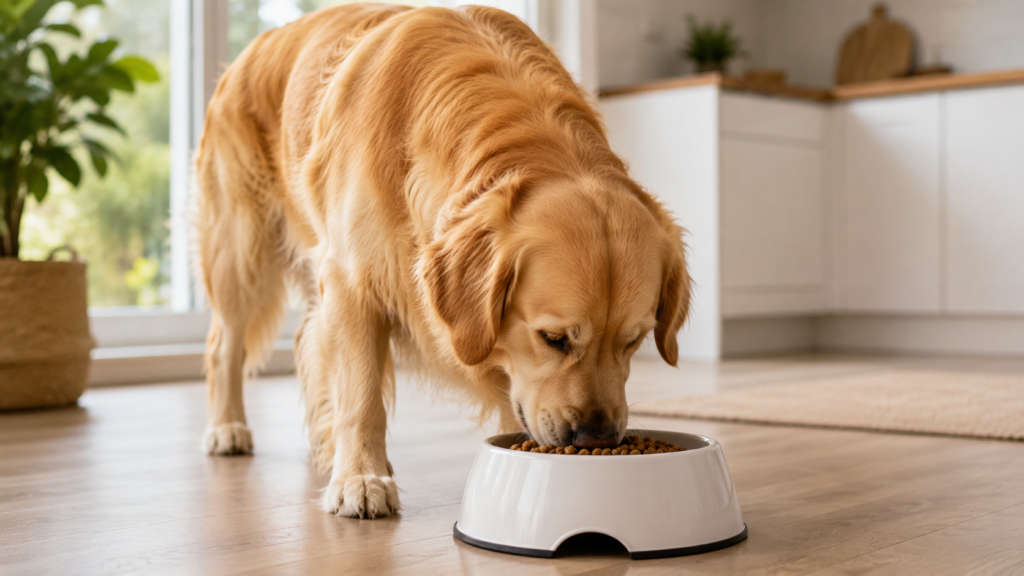
What should you actually look for in Golden Retriever food?
Start with nutritional adequacy rather than ingredient-list marketing.
A useful shortlist is:
- Complete and balanced for the appropriate life stage
- Calorie density that fits your dog’s actual activity
- Portions that allow your Golden to stay at an appropriate body condition
- A formulation your individual dog tolerates consistently
- Clear feeding and calorie information
- Appropriate manufacturer expertise and quality-control practices
- A food you can feed consistently and realistically
There is no evidence-based Golden Retriever target such as “25% protein,” “moderate fat,” or a particular fiber percentage that every dog in the breed should receive.
The right diet depends on life stage, activity, health, body condition, and the individual dog.
Weight control is not generic advice for Golden Retrievers
Golden Retrievers have shown an elevated risk of becoming overweight in epidemiological research.
That makes calorie control especially relevant when choosing and feeding their food.
The important number is not just how many cups go into the bowl.
Look at:
- Calories per cup, can, tray, or gram
- The amount you actually feed
- Treats
- Chews
- Training rewards
- Table extras
- Changes in activity
- Weight trend over time
- Body Condition Score
Two foods can have similar-looking feeding instructions but very different calorie densities.
And two Golden Retrievers of similar weight may need different portions if one spends weekends hiking or retrieving while the other has a quieter routine.
Feed the Golden in front of you, not the breed stereotype
Goldens are often thought of as active sporting dogs.
Some are.
Others are companion dogs with moderate exercise.
A field, hunting, or sport Golden working regularly may need substantially more energy than a household Golden whose routine consists of walks, play, and everyday training.
Do not choose an energy-dense performance food solely because the breed has working origins.
Likewise, do not assume a highly active Golden should eat the same amount as a less active dog of identical body weight.
Match calorie intake to real workload and monitor the result.
A practical way to judge whether you are feeding the right amount
Start with the manufacturer’s feeding guidance, but treat it as an estimate rather than a prescription.
Then monitor the dog.
You should be able to feel the ribs without pushing through a heavy layer of fat, and there should be a discernible waist when viewed from above.
The Golden’s coat can make visual assessment less obvious, so use your hands as well as your eyes.
A simple routine works well:
- Measure food rather than repeatedly eyeballing portions
- Record your dog’s weight periodically
- Check body condition
- Include rewards and extras in the daily calorie picture
- Reassess portions when exercise changes
- Make gradual adjustments based on trend, not one weigh-in
If you are unsure what an appropriate body condition looks like, ask your veterinarian to show you how to use a Body Condition Score.
Training treats count more than many owners realize
Food rewards are useful for training, but they are still food.
A general nutritional guideline is to keep treats and other foods that are not complete and balanced to no more than about 10% of daily calories.
That principle is relevant for any dog, but it deserves extra attention in a breed with a documented tendency toward overweight.
If you train frequently, consider using:
- Very small rewards
- Lower-calorie treats where appropriate
- Part of the dog’s normal food allowance for training
The goal is not to stop rewarding your Golden.
It is to avoid accidentally adding a second meal through dozens of small rewards.
Golden Retriever puppy food: growth is worth getting right
Puppy nutrition is one of the most important parts of this page.
Golden Retrievers sit around the nutritional threshold used for large-size growth, and many males are expected to reach or exceed 70 lb as adults.
That does not mean every Golden Retriever puppy automatically qualifies as a large-size dog under AAFCO growth criteria.
The expected adult size of the individual matters.
What Golden puppies need
Choose a diet that is complete and balanced for growth.
If your puppy is expected to reach 70 lb or more as an adult, choose a food formulated to meet the requirements for growth of large-size dogs.
The objective is controlled development, not maximum growth speed.
Priorities include:
- Appropriate calorie intake
- Keeping the puppy lean
- Monitoring weight and body condition
- Avoiding chronic overfeeding
- Using an appropriately formulated growth diet
- Avoiding indiscriminate calcium or mineral supplementation
More food does not create a healthier or stronger adult dog.
Do Golden Retriever puppies need extra calcium?
Do not add calcium or mineral supplements to a properly formulated puppy diet unless your veterinarian specifically recommends them.
Growing large dogs need appropriate mineral balance, not simply “more calcium.”
Adding supplements to an already complete growth diet can disrupt that balance.
Joint health starts with growth and body condition
Hip and elbow dysplasia are genuine orthopedic concerns in Golden Retrievers.
That makes nutrition relevant, but not in the way supplement marketing sometimes implies.
The strongest practical priorities are:
- Appropriate growth during puppyhood
- Avoiding excess calorie intake
- Maintaining healthy body condition throughout life
- Adjusting intake when activity decreases
This does not mean every Golden needs a “joint food.”
It also does not mean glucosamine, chondroitin, or another supplement can prevent hip or elbow dysplasia.
Joint ingredients may have roles in particular dogs, but they should not replace the basics of appropriate weight and veterinary care.
The Golden Retriever DCM and taurine question deserves context
Golden Retrievers have a particularly important place in the discussion around diet-associated taurine deficiency and dilated cardiomyopathy.
Published research has documented Golden Retrievers with both taurine deficiency and DCM in association with certain dietary patterns.
In one prospective study involving 24 affected Golden Retrievers, 23 had been eating diets described as grain-free, legume-rich, or both.
Following veterinary management that included dietary change and taurine supplementation when clinically indicated, 23 of the 24 dogs showed substantial improvement in echocardiographic measurements together with normalization of taurine status.
That is important evidence.
It is not evidence that every grain-free food causes DCM.
What the evidence does not mean
It does not establish that:
- Every Golden eating grain-free food will develop DCM
- Peas or lentils are inherently toxic
- Every case of DCM in a Golden Retriever is diet-related
- All grain-free diets are nutritionally identical
- Every Golden needs taurine supplementation
- Added taurine on a label guarantees protection from DCM
Diet-associated DCM appears to be more complicated than one ingredient.
Current understanding points toward a potentially multifactorial interaction involving diet formulation, ingredient patterns, processing, nutrient digestibility or bioavailability, genetics, and individual susceptibility.
The FDA has not established a single ingredient as the cause.
Should you avoid grain-free food?
There is no Golden Retriever-specific nutritional reason to choose grain-free food routinely.
If a grain-free diet is being used without a medical reason, it is reasonable to discuss the choice with your veterinarian, particularly given the Golden-specific DCM literature.
The more useful question is not simply:
“Does this food contain grains?”
It is:
“Is this a nutritionally sound diet from a manufacturer with strong formulation and quality-control practices, and is it appropriate for this dog?”
Does every Golden Retriever need taurine?
No.
The published Golden Retriever evidence makes taurine clinically relevant in the right context, but routine supplementation of the entire breed is not established.
Do not attempt to prevent or treat DCM by adding taurine on your own.
If your veterinarian suspects DCM, taurine deficiency, or another diet-associated cardiac issue, testing and supplementation decisions should be made as part of a veterinary workup.
An itchy Golden does not automatically need a different protein
Golden Retrievers have a recognized predisposition to canine atopic dermatitis.
Atopy is not the same thing as food allergy.
That distinction matters because an itchy Golden is sometimes switched immediately to:
- Chicken-free food
- Beef-free food
- Grain-free food
- Fish-based food
- Limited-ingredient diets
without evidence that food is actually responsible.
There is not sufficient basis to tell Golden Retriever owners that chicken, beef, wheat, corn, soy, or dairy are routine breed-specific triggers.
What to do if food allergy is genuinely suspected
Persistent itching, recurrent skin or ear disease, gastrointestinal signs, or another ongoing problem deserves veterinary evaluation.
When an adverse food reaction is genuinely suspected, a controlled elimination diet followed by an appropriate challenge is much more informative than randomly cycling through commercial foods.
Do not assume that temporary improvement after changing foods proves which ingredient caused the problem.
Other conditions can improve or fluctuate at the same time.
Does a Golden Retriever need omega-3 or fish oil?
Not simply because it is a Golden Retriever or because the breed has a double coat.
EPA and DHA can be useful nutrients in particular circumstances, including some dermatologic and inflammatory conditions, and they may have therapeutic relevance in dogs with osteoarthritis.
That is different from saying every healthy Golden requires an omega-3 supplement.
Some complete foods already contain meaningful amounts.
Whether additional supplementation is useful depends on the diet, the dog, and the reason for using it.
Protein: there is no Golden-specific target
Golden Retrievers need adequate dietary protein and essential amino acids, as all dogs do.
There is no established breed-specific protein percentage that makes a food better for Goldens.
A highly active field dog and a sedentary older companion may differ substantially in nutritional needs, but those differences come from the individual situation rather than a Golden Retriever protein rule.
Do not choose between foods based solely on which bag shows the larger protein number.
Fat matters mainly because it changes calorie density
There is no universal Golden Retriever fat percentage either.
Dietary fat provides energy and increases calorie density.
That can be useful for a dog performing sustained work.
For a Golden prone to gaining excess weight, an energy-dense food can also make portion control more difficult.
Instead of searching for “moderate-fat Golden Retriever food,” compare the calories in the foods you are considering and ask whether that energy density fits your dog’s real activity level.
Companion Golden vs field or sport Golden
This is one area where the same breed can require very different feeding strategies.
Companion Golden
A normally active companion dog may do well on an adult maintenance diet with moderate calorie density and appropriately measured portions.
More concentrated performance nutrition is not automatically an upgrade.
Field, hunting or sport Golden
A Golden doing sustained retrieving, hunting, field work, or demanding sport may require substantially more calories.
In that context, greater energy density can be useful because it allows the dog to obtain more energy without excessively increasing food volume.
Changes should be driven by:
- Workload
- Body condition
- Weight trend
- Recovery
- Overall health
rather than by the label “working breed.”
Golden whose activity has dropped
Calorie needs can change after injury, illness, seasonal changes, aging, or a shift in household routine.
If exercise drops but food does not, gradual weight gain can follow.
Reassess the amount being fed before assuming you need a new brand or a special weight-control supplement.
What should an older Golden Retriever eat?
There is no universal age when every Golden should switch to senior food.
Aging should trigger reassessment rather than an automatic product change.
Look at:
- Body Condition Score
- Muscle Condition Score
- Activity
- Weight trend
- Appetite
- Dental health
- Medical conditions
- Current calorie intake
Some older dogs need fewer calories as activity declines.
Others need careful attention to preserving muscle and maintaining adequate protein intake.
“Senior” does not automatically mean “low protein.”
If your Golden develops a medical condition that changes nutritional requirements, diet selection should be based on that condition with veterinary guidance.
Dry, wet, fresh, raw or home-prepared?
No feeding format has been shown to be inherently best for Golden Retrievers.
Dry food
Dry food can be convenient, easy to store, and straightforward to measure.
Its value depends on nutritional adequacy and formulation, not simply on being kibble.
Wet food
A complete and balanced wet diet can be used alone or alongside another food.
Check whether the product is intended as a complete diet or only for supplemental feeding.
Commercial fresh food
Fresh diets can be appropriate when they are properly formulated and nutritionally complete.
Terms such as “fresh” and “human-grade” do not by themselves prove superior nutrition or digestibility for Golden Retrievers.
Raw food
Raw feeding is not a Golden-specific nutritional requirement and should not be promoted as a method to prevent allergy, improve coat quality, or reduce cancer risk.
Raw diets also raise food-safety and nutritional-balance considerations that should be weighed carefully.
Home-prepared diets
A homemade diet can be appropriate when formulated correctly.
Meat, rice, vegetables, and supplements assembled by intuition do not reliably create a complete diet.
For long-term home feeding, use a recipe formulated for your dog by a qualified veterinary nutrition professional.
How to compare two Golden Retriever foods without relying on marketing
Turn the bags around.
Ignore for a moment:
- Breed pictures
- “Premium” wording
- “Natural” claims
- Ingredient-list aesthetics
- Whether meat appears first
- High-protein marketing
- Grain-free positioning
Instead, compare what actually helps you make a feeding decision.
Ask:
- Is the food complete and balanced for the required life stage?
- If this is for a puppy expected to reach 70 lb or more, is it appropriate for large-size growth?
- How many calories does it provide per cup, can, tray, or gram?
- Does that energy density fit this dog’s workload?
- Can you maintain an appropriate body condition on practical portions?
- What nutritional expertise is involved in formulation?
- What quality-control information does the manufacturer provide?
- Does the company provide meaningful nutrient and calorie information?
- Does your dog tolerate and eat the diet consistently?
- Can you feed it reliably over time?
A visually attractive ingredient list cannot answer those questions by itself.
Do Golden Retrievers need breed-specific commercial food?
No Golden Retriever has a physiological requirement for a food simply because the package says “Golden Retriever.”
A breed-targeted product can still be an appropriate food.
But its suitability should be judged by the same nutritional standards as any other formula.
Breed branding is not evidence that the product is automatically superior.
Changing foods
Golden Retrievers do not require a special breed-specific transition schedule.
For dogs in general, changing foods gradually can reduce the likelihood of gastrointestinal upset.
A common approach is to mix progressively more of the new food with less of the previous food over several days.
Some dogs tolerate changes quickly; others benefit from a slower transition.
If vomiting, persistent diarrhea, blood in the stool, loss of appetite, marked lethargy, or another concerning sign develops, contact your veterinarian rather than assuming the food switch is the only possible explanation.
Common Golden Retriever feeding mistakes
Letting the coat hide gradual weight gain
Golden Retrievers can carry extra body fat without the change looking dramatic from a distance.
Use hands-on body condition checks and weight trends, not appearance alone.
Choosing food for the breed’s reputation instead of actual activity
A companion Golden does not need field-dog calories simply because Golden Retrievers were developed as sporting dogs.
Treating every itch as a food allergy
Atopy and food allergy are different problems.
Random ingredient restriction can make feeding more complicated without identifying the cause.
Trying to solve joint risk with supplements first
For a healthy Golden, appropriate puppy growth and body condition are more fundamental nutritional priorities than automatically adding joint ingredients.
Adding taurine “just in case”
Golden Retrievers deserve special attention in the diet-associated DCM discussion, but that does not turn taurine supplementation into routine preventive care for the breed.
Assuming grain-free means better or dangerous by definition
Neither shortcut accurately represents the evidence.
Evaluate the complete diet and the individual dog.
FAQ — Golden Retriever food
What is the best food for a Golden Retriever?
There is no single best food for every Golden Retriever.
Choose a complete and balanced diet appropriate for life stage, then match calorie density and portions to body condition, weight trend, and actual activity.
For Golden puppies, growth suitability deserves particular attention.
How much should a Golden Retriever eat?
There is no reliable breed-wide amount.
Use the manufacturer’s feeding guidance as a starting point, account for treats and extras, then adjust according to body condition and weight trend.
Calorie density varies significantly between foods, so cups alone are not a useful universal measure.
Should Golden Retrievers eat large-breed puppy food?
It depends on expected adult size.
Golden Retrievers sit near the threshold, and many males are expected to reach or exceed 70 lb.
When a puppy is expected to reach at least 70 lb as an adult, choose a diet appropriate for growth of large-size dogs.
Not every individual Golden automatically meets that criterion.
Are Golden Retrievers prone to food allergies?
Golden Retrievers have a recognized predisposition to atopic dermatitis, but that should not be confused with a proven breed-wide tendency toward specific food allergies.
Chicken, beef, grains, and other ingredients should not be removed solely because the dog is a Golden Retriever.
Is grain-free food bad for Golden Retrievers?
The answer is more nuanced than yes or no.
Golden Retrievers are particularly relevant to research on diet-associated taurine deficiency and DCM, and grain-free or legume-rich dietary patterns were common among affected dogs in an important published study.
That does not prove that grain-free food alone causes DCM.
Given the breed-specific evidence, diet choice should focus on sound formulation and can be discussed with your veterinarian if you have concerns.
Should I give my Golden Retriever taurine?
Not routinely just because of breed.
Taurine testing or supplementation can be clinically relevant when taurine deficiency or diet-associated DCM is suspected, but that should be handled with veterinary guidance.
Do Golden Retrievers need joint supplements?
Not automatically.
Healthy body condition and appropriate puppy growth are foundational priorities.
If your Golden has an orthopedic condition or mobility problem, discuss diet and supplements with your veterinarian based on the individual case.
Does my senior Golden need senior dog food?
Not necessarily.
Reassess calories, body and muscle condition, activity, appetite, and medical needs rather than switching foods solely because your dog has reached a particular age.
Next steps
For Golden Retriever health concerns beyond feeding:
For broader dog nutrition guidance:
dog nutrition guidance
For age-specific care:
age-specific dog care
Affiliate disclosure
Doglira may earn a commission from qualifying purchases made through links on this site, at no additional cost to you.
Any future product recommendations on this page should be selected for nutritional suitability and usefulness to the reader, not because a product offers an affiliate commission.